
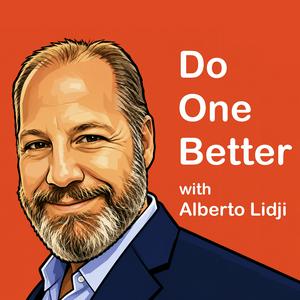
Do One Better with Alberto Lidji in Philanthropy, Sustainability and Social Entrepreneurship
400 episodios
They never went to Oxford or Cambridge — now they run two colleges there. Engines of social mobility at two of the world’s best universities
19/10/2026 | 42 minNeither of them ever studied at Oxford or Cambridge. Now they each run a college there.
In this milestone 400th episode, Alberto sits down with Professor Beth Breeze, Principal of Harris Manchester College, Oxford, and Girish Menon, President of Lucy Cavendish College, Cambridge, to find out how their two colleges have become genuine engines of social mobility inside Oxbridge — as Brits refer to Oxford and Cambridge — institutions many people still assume were only ever built to welcome one particular kind of applicant.
How does one Cambridge college end up with one of the highest proportions of state-school students in the university’s history, without lowering its entry grades?
What happens to a bright student who’s told, after a single open day, that he should probably just “settle” for somewhere closer to home?
Why did it take a teacher noticing “a spark” — not a family connection — to get one student through the gates at all?
What’s actually covered, and what isn’t, once a scholarship pays for tuition but a student still needs a bike, a set of academic robes, or rent?
Can two heads of college who never earned an Oxford or Cambridge degree themselves see something the system’s own insiders can’t?
Press play to hear exactly how two unlikely college heads are rewriting who gets to belong at two of the world’s best universities.
Visit our Knowledge Hub at Lidji.org for information on 400 case studies and interviews with remarkable leaders in philanthropy, sustainability and social entrepreneurship.Neural implants are already restoring movement, and showing early signs of restoring memory — Tris Dyson on the moonshot prizes behind the breakthrough
12/10/2026 | 32 minIn 1714, Britain's Parliament passed the Longitude Act, offering a cash prize of up to £20,000, worth well over £2 million today, to anyone who could solve a problem that had defeated Galileo and Isaac Newton: how to measure longitude accurately at sea. Tris Dyson, Founder and Executive Director of Challenge Works, runs an organisation built on that same core idea, using big incentive competitions to accelerate breakthroughs in fields ranging from space exploration and agri-tech to urban innovation. But as Tris explains, a modern challenge prize is rarely just about the money: getting the incentives right can mean building in access to data, accelerated regulatory pathways, and new partnerships alongside any financial reward.
One of the problems Challenge Works is currently taking on is also deeply personal for Tris. Three and a half years ago, he was diagnosed with ALS and told he had three to five years to live. In this episode, he joins Alberto Lidji to talk about challenge prizes more broadly, and about the prize he's helping build that could change the odds, for himself and for millions of others living with neurodegenerative disease.
Tris explains what it actually takes to design a challenge prize that works, drawing on examples from the original Longitude Prize to today's hunt for solutions to antimicrobial resistance and even extracting drinking water from lunar rock, and what has to be in place, the right target, the right incentives, the right enabling environment, before a single team ever starts competing.
Neural implants are already restoring movement in people with Parkinson's, and showing early promise for memory too. Tris also talks about "brain twins" that could let scientists test new treatments without ever touching a real brain, and why he believes the biggest obstacle standing in the way of curing these diseases isn't the science, but the bureaucracy sitting on top of it. This episode is for anyone who believes in the power of ambitious thinking to drive breakthroughs.
Visit our Knowledge Hub at Lidji.org for information on 350+ case studies and interviews with remarkable leaders in philanthropy, sustainability and social entrepreneurship.Flora Alexander, Executive Director of the International Rescue Committee UK, on why some conflicts miss the headlines and how donors can be sure their money reaches those in need
05/10/2026 | 32 minEvery year, the International Rescue Committee publishes an Emergency Watchlist predicting the twenty countries most likely to face a major humanitarian crisis in the year ahead. For the past three years, the country at the top of that list, Sudan, has received comparatively modest media coverage next to crises like Ukraine, despite being, by the numbers, the world's largest humanitarian emergency.
In this episode, Flora Alexander, Executive Director of the International Rescue Committee UK (IRC UK), joins Alberto Lidji to explore why some of the world's most severe conflicts struggle to make the headlines, and how donors can be confident that the money they give actually reaches the people who need it.
Founded in 1933 at Albert Einstein's urging to help Jewish refugees fleeing Nazi persecution, the IRC today works across the full arc of crisis — from Ukraine to the Democratic Republic of the Congo, and from resettlement programmes in the UK to frontline health clinics around the world.
What determines whether a humanitarian emergency becomes a story the world can't look away from, rather than one that quietly falls off the agenda? And if you wanted to help the people of a country whose leadership you have every reason to distrust, without a penny of that money ever touching the regime itself, what would it actually take to ensure your donation got to where it was needed?
Flora succeeds David Miliband, the IRC's global President and Chief Executive, who was a guest on the Do One Better Podcast in 2021, and Laura Kyrke-Smith, her predecessor as IRC UK's Executive Director, who appeared on the show in 2023 before being elected as a Member of Parliament in the UK.
Visit our Knowledge Hub at Lidji.org for information on 350+ case studies and interviews with remarkable leaders in philanthropy, sustainability and social entrepreneurship.Charles Li, Founder and Chairman of Micro Connect, on connecting big finance to the little guy — a special series marking the 10th anniversary of the PBC Forum
28/09/2026 | 24 minCharles Li spent over a decade running one of the world's major stock exchanges and chairing JP Morgan China before turning his attention to an entirely different challenge: bringing institutional capital to small businesses — franchise owners, landlords, and local shopkeepers — that Wall Street has traditionally struggled to reach. In this episode, Charles, Founder and Chairman of Micro Connect, joins Alberto Lidji to explore how institutional capital might finally find its way to the small businesses that need it most.
This conversation was recorded at the PBC 2026 Forum — Philanthropy for Better Cities 2026 — in Hong Kong, and forms part of a special series made possible by the Hong Kong Jockey Club, marking the forum's 10th anniversary, convened by The Hong Kong Jockey Club Charities Trust, in association with the Institute of Philanthropy.
What does it take to convince Wall Street investors to back a business model built on the transparency of everyday transactions rather than traditional balance sheets? How does artificial intelligence change what's possible when it comes to assessing risk at that scale? And what can decades spent inside the world's biggest financial institutions teach us about building something entirely new for the world's smallest ones?
Charles also reflects on his own path, from working on an oil rig, to Columbia Law School, to the top of Hong Kong's stock exchange — and what that journey tells us about reinventing yourself as the world around you changes.
About Charles Li: He was appointed Chairman of JP Morgan China from 2003 to 2009. He joined Merrill Lynch in 1994, where he served as President of Merrill Lynch China from 1999 to 2003. He holds a BA in English Literature from Xiamen University, an MA in Journalism from the University of Alabama, and a JD from Columbia Law School.
Visit our Knowledge Hub at Lidji.org for information on 350+ case studies and interviews with remarkable leaders in philanthropy, sustainability and social entrepreneurship.Brian San, Secretary General of the Institute of Philanthropy in Hong Kong, on Asia's philanthropic ecosystems — a special series marking the 10th anniversary of the PBC Forum
21/09/2026 | 26 minAcross Asia, philanthropy takes markedly different forms — from mass individual and faith-based giving to corporate mandates and state-led funds. Brian San, Secretary General of the Institute of Philanthropy in Hong Kong, sheds light on twelve playbooks the Commission on Asian Philanthropy has identified as proven models: built in one market and ready to travel to others. In this episode, Brian joins Alberto Lidji to unpack what's actually working in Asian philanthropy, and why.
This conversation was recorded at the PBC 2026 Forum — Philanthropy for Better Cities 2026 — in Hong Kong, and forms part of a special series made possible by the Hong Kong Jockey Club, marking the forum's 10th anniversary, convened by The Hong Kong Jockey Club Charities Trust, in association with the Institute of Philanthropy.
Brian discusses the Institute of Philanthropy's work co-convening the Commission on Asian Philanthropy alongside the Asia Philanthropy Congress, set up by the Nippon Foundation, bringing together thirteen of Asia's most influential foundations, and their interim report, published in September 2026, "Strengthening Asia's Philanthropic Ecosystems for Inclusive and Sustainable Growth by 2050," with a final report due in Tokyo in December 2027.
Brian explains why each giving model's real value lies beyond the money itself, in the technology, supply chains, and community trust that different actors bring to bear, and why understanding a model's underlying objectives and constraints matters more than assuming a single shared goal across the sector.
Useful link: Commission on Asian Philanthropy
Visit our Knowledge Hub at Lidji.org for information on 350+ case studies and interviews with remarkable leaders in philanthropy, sustainability and social entrepreneurship.






Escucha Do One Better with Alberto Lidji in Philanthropy, Sustainability and Social Entrepreneurship, Dinstinto y muchos más podcasts de todo el mundo con la aplicación de radio.net
Descarga la app gratuita: radio.net
- Añadir radios y podcasts a favoritos
- Transmisión por Wi-Fi y Bluetooth
- Carplay & Android Auto compatible
- Muchas otras funciones de la app
Descarga la app gratuita: radio.net
- Añadir radios y podcasts a favoritos
- Transmisión por Wi-Fi y Bluetooth
- Carplay & Android Auto compatible
- Muchas otras funciones de la app

Do One Better with Alberto Lidji in Philanthropy, Sustainability and Social Entrepreneurship
Descarga la app,
Escucha.
 Colombia

