
Escucha gratis este podcast en la aplicación: Descarga gratuita en la App Store
radio.net
Sleep timer
Favoritos
64 episodios
2 Ways to Sleep Better and Be Happier
19/10/2026 | 45 minWe all know how important sleep is for our health and happiness. So why do we resist going to bed, even when we know we should?
In this episode of Office Hours, I explore the science of sleep and how it affects our well-being. I explain why we sometimes sacrifice sleep for a little extra time to ourselves, a phenomenon known as "revenge bedtime procrastination," and what it reveals about our need for control. I also share two ways to change your relationship with sleep, along with my own nightly routine.
—
Brought to you by:
• Noble Mobile—With Noble, there is only one plan: The No-Bull Plan. It’s simple. It’s transparent. And if you use less data, you get cash back. Get an exclusive offer at: https://noblemobile.com/arthurbrooks.
—
Where to find Arthur Brooks:
• Website: https://arthurbrooks.com/
• In-person Retreats: https://retreats.arthurbrooks.com/
• Newsletter: https://www.arthurbrooks.com/newsletter
• X: https://x.com/arthurbrooks
• Instagram: https://www.instagram.com/arthurcbrooks/
• Facebook: https://www.facebook.com/ArthurBrooks/
• YouTube: https://www.youtube.com/channel/UCGuyFRjJQFGCKzfHTBvWM6A
• LinkedIn: https://www.linkedin.com/in/arthur-c-brooks/
• Email: officehours@arthurbrooks.com
—
Timestamps:
(00:00) Intro
(05:42) The sleep deprivation epidemic
(08:27) How sleep affects your health and well-being
(13:46) Four common barriers to sleep
(15:58) Bedtime procrastination
(19:22) Revenge bedtime procrastination
(24:22) #1. Quell your inner tyrant
(28:42) #2. Go from physical to metaphysical
(36:14) My personal sleep routine
(41:33) Q&A: Dealing with shifting ambition
(42:34) Q&A: Why men struggle more with friendship than women
—
Referenced:
• The Meaning of Your Life: Finding Purpose in an Age of Emptiness: themeaningofyourlife.com
• Arthur’s newsletter: https://www.arthurbrooks.com/newsletter
• The Happiness Scale: https://learn.arthurbrooks.com/the-happiness-scale
• Retreats: https://retreats.arthurbrooks.com
• Huberman Lab: https://www.hubermanlab.com
• About Sleep: https://www.cdc.gov/sleep/about/index.html
• Changes in Sleep Duration, Quality, and Medication Use Are Prospectively Associated With Health and Well-being: Analysis of the UK Household Longitudinal Study: https://pubmed.ncbi.nlm.nih.gov/28364423
• The role of sleep in cognition and emotion: https://pubmed.ncbi.nlm.nih.gov/19338508
• ...References continued at: https://www.arthurbrooks.com/office-hoursMy 3-Step Protocol for Managing Anxiety
12/10/2026 | 49 minIf you struggle with anxiety, you might wish you could get rid of it altogether. But your brain’s alarm system exists for a reason. The trouble is that the way we live today can set it off far more often than it should.
In this episode of Office Hours, I break down what anxiety actually is and what chronic anxiety does to your body. The key is understanding when anxiety is hurting us and when it can help us. I share three simple but powerful strategies to manage your anxiety and create more opportunities for happiness, adventure, and meaning in your life.
—
Brought to you by:
• Noble Mobile—With Noble, there is only one plan: The No-Bull Plan. It’s simple. It’s transparent. And if you use less data, you get cash back. Get an exclusive offer at: https://noblemobile.com/arthurbrooks.
• Helix Sleep—A mattress designed for every body. Go to helixsleep.com/brooks for 27% off sitewide for their Labor Day Sale—an exclusive offer for listeners of Office Hours.
—
Where to find Arthur Brooks:
• Website: https://arthurbrooks.com/
• In-person Retreats: https://retreats.arthurbrooks.com/
• Newsletter: https://www.arthurbrooks.com/newsletter
• X: https://x.com/arthurbrooks
• Instagram: https://www.instagram.com/arthurcbrooks/
• Facebook: https://www.facebook.com/ArthurBrooks/
• YouTube: https://www.youtube.com/channel/UCGuyFRjJQFGCKzfHTBvWM6A
• LinkedIn: https://www.linkedin.com/in/arthur-c-brooks/
• Email: officehours@arthurbrooks.com
—
Timestamps:
(00:00) Intro
(07:36) What anxiety is
(12:07) Why we need anxiety and when it becomes too much
(16:00) Why anxiety is rising among young people
(17:08) What devices do to your brain
(23:05) Why trying to eliminate anxiety falls short
(26:36) Some positives of anxiety
(31:08) #1: Accept your anxiety
(33:37) #2: Reframe your anxiety
(36:01) #3: Lean into the source of your anxiety
(41:29) Q&A: Struggling with addiction as a Poet PANAS type
(44:57) Q&A: Modifying protocols for your health and lifestyle
(47:08) Q&A: The value of daydreaming
—
Referenced:
• The Meaning of Your Life: Finding Purpose in an Age of Emptiness: https://www.arthurbrooks.com/the-meaning-of-your-life
• Meaning Membership: https://hub.arthurbrooks.com/the-meaning-membership
• Arthur’s newsletter: https://www.arthurbrooks.com/newsletter
• The Happiness Scale: https://learn.arthurbrooks.com/the-happiness-scale
• The Pursuit of Happiness with Arthur Brooks: https://www.thefp.com/s/the-pursuit-of-happiness-with-arthur
• Marines on Netflix: https://www.netflix.com/title/81750378
• Søren Kierkegaard: https://en.wikipedia.org/wiki/S%C3%B8ren_Kierkegaard
• Surviving Anxiety: https://www.theatlantic.com/magazine/archive/2014/01/surviving_anxiety/355741
• Trends in anxiety among adults in the United States, 2008-2018: Rapid increases among young adults: https://pubmed.ncbi.nlm.nih.gov/32905958
• ...References continued at: https://www.arthurbrooks.com/office-hours3 Ways to Stop Letting Your Past Control Your Life
05/10/2026 | 47 minAre painful memories keeping you from enjoying your life today? Maybe you avoid a particular place or person because of an experience you can’t seem to let go of.
In this episode of Office Hours, I explore how memory works, why our recollections are less reliable than we think, and how the past shapes the future we imagine. As always, I share practical steps to help you find more happiness, meaning, and gratitude as you move forward.
—
Brought to you by:
• Noble Mobile—With Noble, there is only one plan: The No-Bull Plan. It’s simple. It’s transparent. And if you use less data, you get cash back. Get an exclusive offer at: https://noblemobile.com/arthurbrooks.
• Magic Mind—Magic Mind is a mental performance shot with vitamins and clinically-backed ingredients like Ashwagandha and Lion’s Mane for a sharper mind and sustained energy. Get 50% off your first order at magicmind.com.
—
Where to find Arthur Brooks:
• Website: https://arthurbrooks.com/
• In-person Retreats: https://retreats.arthurbrooks.com/
• Newsletter: https://www.arthurbrooks.com/newsletter
• X: https://x.com/arthurbrooks
• Instagram: https://www.instagram.com/arthurcbrooks/
• Facebook: https://www.facebook.com/ArthurBrooks/
• YouTube: https://www.youtube.com/channel/UCGuyFRjJQFGCKzfHTBvWM6A
• LinkedIn: https://www.linkedin.com/in/arthur-c-brooks/
• Email: officehours@arthurbrooks.com
—
Timestamps:
(00:00) Intro
(09:21) The science of human memory
(19:09) Why memories are unreliable
(23:09) Why memories shift
(30:03) #1. To reconstruct your past: Keep a database of positive memories
(34:22) #2. Focus on gratitude
(35:50) #3. Look for meaning and learning
(43:00) Q&A: Teaching lessons from The Meaning of Your Life to kids
(43:58) Q&A: Handling uncertainty about AI replacing jobs
—
Referenced:
• The Meaning of Your Life: Finding Purpose in an Age of Emptiness:https://www.arthurbrooks.com/the-meaning-of-your-life
• Arthur’s newsletter: https://www.arthurbrooks.com/newsletter
• The Happiness Scale: https://learn.arthurbrooks.com/the-happiness-scale
• The Pursuit of Happiness with Arthur Brooks: https://www.thefp.com/s/the-pursuit-of-happiness-with-arthur
• Self-Reliance: https://nationalhumanitiescenter.org/pds/triumphnationalism/cman/text8/selfreliance.pdf
• Remembering the past to imagine the future: the prospective brain: https://pubmed.ncbi.nlm.nih.gov/17700624
• Phantom flashbulbs: False recollections of hearing the news about Challenger: https://psycnet.apa.org/record/1993-97049-001
• You Won’t Remember the Pandemic the Way You Think You Will: https://www.theatlantic.com/magazine/archive/2021/05/how-will-we-remember-covid-19-pandemic/618397
• Emotion and memory research: A grumpy overview: https://guilfordjournals.com/doi/10.1521/soco.22.5.530.50767
• Memories affect mood: evidence from covert experimental assignment to positive, neutral, and negative memory recall: https://pubmed.ncbi.nlm.nih.gov/16945317
• PANAS quiz: https://www.arthurbrooks.com/panas
• ...References continued at: https://www.arthurbrooks.com/office-hours4 Ways to Avoid Your Professional Decline
28/09/2026 | 51 minWhat happens when the abilities that brought you professional success start to decline?
In this episode of Office Hours, I explore how our strengths change with age and how to be happier as they do. Drawing on my book From Strength to Strength, I explain fluid and crystallized intelligence and contrast how Darwin and Bach responded to professional decline.
As always, I leave you with practical steps to help you navigate this transition and find more happiness, meaning, and fulfillment as you age.
—
Brought to you by:
• LMNT—A science-backed electrolyte drink mix that helps you feel and perform your best, without sugar, artificial ingredients, or gimmicks. Get a free sample pack at DrinkLMNT.com/Arthur
• Helix Sleep—A mattress designed for every body. Go to helixsleep.com/brooks for 27% off sitewide for their Labor Day Sale—an exclusive offer for listeners of Office Hours.
—
Where to find Arthur Brooks:
• Website: https://arthurbrooks.com/
• In-person Retreats: https://retreats.arthurbrooks.com/
• Newsletter: https://www.arthurbrooks.com/newsletter
• X: https://x.com/arthurbrooks
• Instagram: https://www.instagram.com/arthurcbrooks/
• Facebook: https://www.facebook.com/ArthurBrooks/
• YouTube: https://www.youtube.com/channel/UCGuyFRjJQFGCKzfHTBvWM6A
• LinkedIn: https://www.linkedin.com/in/arthur-c-brooks/
• Email: officehours@arthurbrooks.com
—
Timestamps:
(00:00) Intro
(10:40) How happiness changes with age
(15:09) Who is happiest after 70
(17:40) The inevitability of age-related decline in our abilities
(21:49) Lessons on aging from the lives of Darwin and Bach
(32:05) Why our abilities decline with age
(39:01) #1. Jump to the new curve
(40:51) #2. Serve other people
(42:15) #3. Develop your life philosophy
(43:40) #4. Connect more deeply with others
(46:28) Q&A: Navigating relationships with adult children
(47:51) Q&A: Finding meaningful ways to spend retirement
(49:01) Q&A: How to handle “deal” friends
—
Referenced:
• The Meaning of Your Life: Finding Purpose in an Age of Emptiness: https://www.arthurbrooks.com/the-meaning-of-your-life
• Arthur’s newsletter: https://www.arthurbrooks.com/newsletter
• The Happiness Scale: https://learn.arthurbrooks.com/the-happiness-scale
• The Pursuit of Happiness with Arthur Brooks: https://www.thefp.com/s/the-pursuit-of-happiness-with-arthur
• From Strength to Strength: Finding Success, Happiness, and Deep Purpose in the Second Half of Life: https://www.amazon.com/Strength-Finding-Success-Happiness-Purpose/dp/059319148X
• Your Professional Decline Is Coming (Much) Sooner Than You Think: https://www.theatlantic.com/magazine/archive/2019/07/work-peak-professional-decline/590650/
• Is happiness U-shaped everywhere? Age and subjective well-being in 145 countries: https://pmc.ncbi.nlm.nih.gov/articles/PMC7480662
• Creative productivity: A predictive and explanatory model of career trajectories and landmarks: https://psycnet.apa.org/record/1997-02113-002
• Charles Darwin: https://en.wikipedia.org/wiki/Charles_Darwin
• Johann Sebastian Bach: https://en.wikipedia.org/wiki/Johann_Sebastian_Bach
• ...References continued at: https://www.arthurbrooks.com/office-hoursHow to Be More Optimistic with Simon Sinek
21/09/2026 | 56 minSimon Sinek is an optimist, bestselling author of Start with Why, and founder of The Optimism Company.
In this special episode of Office Hours, part of the Be Hope podcast takeover during the United Nations General Assembly, Simon joins me to explore what optimism really requires. We discuss how optimism differs from hope, why relationships help us sustain a belief in a better future, how our expectations shape others, and why pessimism has become so powerful. We also explain how leaders can turn optimism into action through a clear vision, and how each of us can become more optimistic by creating space to imagine a better future and finding a vision worth pursuing.
—
Brought to you by:
• Noble Mobile—With Noble, there is only one plan: The No-Bull Plan. It’s simple. It’s transparent. And if you use less data, you get cash back. Get an exclusive offer at: https://noblemobile.com/arthurbrooks.
• Magic Mind—Magic Mind is a mental performance shot with vitamins and clinically-backed ingredients like Ashwagandha and Lion’s Mane for a sharper mind and sustained energy. Get 50% off your first order at magicmind.com.
—
Where to find Simon Sinek:
• X: https://x.com/simonsinek
• LinkedIn: https://www.linkedin.com/in/simonsinek
• Instagram: https://www.instagram.com/simonsinek
• YouTube: https://www.youtube.com/simonsinek
• Podcast: https://simonsinek.com/podcast
• Website: https://simonsinek.com
Where to find Arthur Brooks:
• Website: https://arthurbrooks.com/
• In-person Retreats: https://retreats.arthurbrooks.com/
• Newsletter: https://www.arthurbrooks.com/newsletter
• X: https://x.com/arthurbrooks
• Instagram: https://www.instagram.com/arthurcbrooks/
• Facebook: https://www.facebook.com/ArthurBrooks/
• YouTube: https://www.youtube.com/channel/UCGuyFRjJQFGCKzfHTBvWM6A
• LinkedIn: https://www.linkedin.com/in/arthur-c-brooks/
• Email: officehours@arthurbrooks.com
—
Timestamps:
(00:00) Intro
(06:10) How Arthur and Simon met
(07:24) Why Simon defines himself as an optimist
(13:10) The difference between optimism and hope
(19:15) How expectations shape relationships and behavior
(28:31) Why optimism is on the decline
(30:39) Why we need leaders with vision
(34:48) How to be more optimistic
(42:42) Optimism in politics
(50:11) Four lessons for becoming more optimistic
(53:55) Advice for leaders
—
Referenced:
• The Meaning of Your Life: Finding Purpose in an Age of Emptiness: https://www.arthurbrooks.com/the-meaning-of-your-life
• Arthur’s newsletter: https://www.arthurbrooks.com/newsletter
• The Happiness Scale: https://learn.arthurbrooks.com/the-happiness-scale
• The Pursuit of Happiness with Arthur Brooks: https://www.thefp.com/s/the-pursuit-of-happiness-with-arthur
• Be Hope Podcast Takeover: https://globalgoals.org/behope/
• The U.N. General Assembly 2026: https://www.un.org/en/high-level-week-2026
• The Power of Why | Simon Sinek: https://www.youtube.com/watch?v=i0rOB91WEOk
• ...References continued at: https://www.arthurbrooks.com/office-hours
Más podcasts de Salud mental








Podcasts a la moda de Salud mental










Acerca de Office Hours with Arthur Brooks
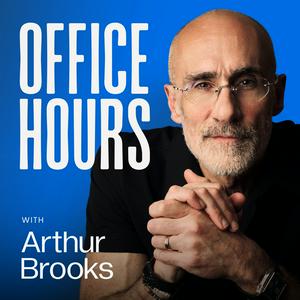
Hi Friends, I’m Arthur Brooks, a social scientist, Vanderbilt professor, and columnist at The Free Press. I write, speak, and teach about the science of human happiness, blending neuroscience, behavioral science, philosophy, and religion for insights on how to live better and be happier. Each week on Office Hours, you’ll get a glimpse into the research on happiness and explore how to use it to improve your life—and share what you learn with those you love. Join me in the movement to build a happier world–starting with you.
Production by penname.co.
Photography by www.calebhargett.com.
Sitio web del podcastEscucha Office Hours with Arthur Brooks, Psicologia Al Desnudo | @psi.mammoliti y muchos más podcasts de todo el mundo con la aplicación de radio.net
Descarga la app gratuita: radio.net
- Añadir radios y podcasts a favoritos
- Transmisión por Wi-Fi y Bluetooth
- Carplay & Android Auto compatible
- Muchas otras funciones de la app
Descarga la app gratuita: radio.net
- Añadir radios y podcasts a favoritos
- Transmisión por Wi-Fi y Bluetooth
- Carplay & Android Auto compatible
- Muchas otras funciones de la app
Office Hours with Arthur Brooks
Escanea el código,
Descarga la app,
Escucha.
Descarga la app,
Escucha.
 Colombia