

Escucha gratis este podcast en la aplicación: Descarga gratuita en la App Store
radio.net
Sleep timer
Favoritos
386 episodios
8 GitHub Repos To Go Viral and Make Money
08/10/2026 | 24 minIn this solo episode, I walk through eight GitHub repos and AI skills that I test at night and on weekends. The list covers launch videos, social research, local voice and dubbing, editable decks, agent teams, lead-magnet tools, idea stress-testing, and design guidance. For each one, I explain what it does, how I'd set it up, and one concrete way to use it to make money or run a business more easily. Most are free to download, and you pay for the model you run them with.
Timestamps
00:00 – Intro
01:25 – Brag: Launch Videos From a Link
04:50 – Agent Reach for Customer Research
07:46 – Voice Studio: Local AI Voice and Dubbing
10:41 – PPT Master: Editable Decks From Notes
12:59 – OpenRig: Coding Agents as a Team
14:57 – Free Tools Skill by Corey Haynes
17:25 – Grill Me Skill by Matt Pocock
19:31 – Impeccable: Design Guidance for Agents
23:03 – My Top Picks: Brag and Agent Reach
24:07 – Closing Thoughts
GitHub Repo Links:
Brag (launch video skill): https://startup-ideas-pod.link/brag
Agent Reach: https://startup-ideas-pod.link/agent-reach
Voice Studio: https://startup-ideas-pod.link/voice-studio
PPT Master: https://startup-ideas-pod.link/ppt-master
OpenRig: https://startup-ideas-pod.link/openrig
Free Tool: https://startup-ideas-pod.link/marketing-skills
Grill Me Skill: https://startup-ideas-pod.link/grill-me
Impeccable Skill: https://startup-ideas-pod.link/impeccable
Key Points
Most of these tools are free to download, and the main cost is the model you run them with.
Work I do for someone up front, like a launch video or a design fix, starts a conversation in place of a cold email.
Posts on Reddit, X, and YouTube show tasks people still do by hand, and a small tool can fix them.
Translated onboarding videos make a recurring monthly service for other companies.
Grill Me logs my assumptions so I check them with a real customer before I build.
Ten clients at $1,000 a month is $10,000 a month, and that cash flow funds the move from services to technology.
The #1 tool to find startup ideas/trends - https://www.ideabrowser.com
LCA helps Fortune 500s and fast-growing startups build their future - from Warner Music to Fortnite to Dropbox. We turn 'what if' into reality with AI, apps, and next-gen products https://latecheckout.agency/
FIND ME ON SOCIAL
X/Twitter: https://twitter.com/gregisenberg
Instagram: https://instagram.com/gregisenberg/
LinkedIn: https://www.linkedin.com/in/gisenberg/How Will People Make Money in the AI Age?
06/10/2026 | 25 minIn this solo episode, I walk through the 13 businesses I think are left to build in the agentic era. I believe that in a world of agents and abundance, owning the right assets puts you in a better position. For each business, I explain what it is, why it holds up in a world of agents, and one or two examples, from Othership's sauna clubs to Osmo's window-cleaning robots. This episode gives you a map of where to build next, at any age.
Timestamps
00:00 – Intro
01:15 – AI-Native Service Firms
02:57 – Offline Businesses
05:41 – Distribution and Organic Audiences
07:34 – Proprietary Data Sets
09:08 – Domain-Specific Harnesses
12:16 – Robotics and Physical AI
14:01 – Physical Products With a Fan Following
16:34 – Compute and Energy
17:31 – Health, Longevity, and Care
19:30 – Marketplaces and Social Networks
21:04 – Real Assets
21:46 – Vertical Agents
22:18 – Security
24:08 – Closing Thoughts
Key Points
In an AI-native service firm, agents do most of the delivery and a human reviews the exceptions.
Ad clicks went from about five cents in 2009 to $1–5 today, so I start with organic audiences.
Proprietary data and domain-specific harnesses are the two gold rushes I see right now.
Offline businesses, niche hardware, and robotics sell rooms, objects, and labor that agents only support.
Compute, energy, and security are the scarce inputs every agent depends on.
The #1 tool to find startup ideas/trends - https://www.ideabrowser.com
LCA helps Fortune 500s and fast-growing startups build their future - from Warner Music to Fortnite to Dropbox. We turn 'what if' into reality with AI, apps, and next-gen products https://latecheckout.agency/
FIND ME ON SOCIAL
X/Twitter: https://twitter.com/gregisenberg
Instagram: https://instagram.com/gregisenberg/
LinkedIn: https://www.linkedin.com/in/gisenberg/Become a $1M/yr FDE (Full Course)
01/10/2026 | 53 minGoogle's most advanced audio models are LIVE, try them for yourself:
Gemini 3.8 Live: https://startup-ideas-pod.link/gemini-3.8-live
Gemini 3.5 Transcribe https://startup-ideas-pod.link/gemini-3.5-transcribe
Gemini 3.5 Live Translate: https://startup-ideas-pod.link/gemini-3.5-live-translate
In this episode, I talk with Vas from Varick about what it takes to put AI to work inside a real company. Vas makes the case that AI pays off through process reengineering, and he walks me through the exact method his forward deployed engineers (FDEs) use: interviews, process mining, step sorting, and agents built inside existing systems of record. We go through real engagements, including a $5B public software company and an accounts payable overhaul that cut the cost per invoice from $31 to $6. By the end, you get a clear picture of the FDE role, the business opportunity behind AI roll-ups, and a five-day plan to start on your own.
Links Mentioned:
FDE Presentation: https://startup-ideas-pod.link/FDE-slides
Vas’s Article: https://startup-ideas-pod.link/vas-fde
Timestamps
00:00 – Intro
01:31 – Sponsor: Google
03:58 – FDE Overview
05:02 – AI Roll-Ups and Process Reengineering
08:04 – The Personal Systems Analogy
09:55 – Understanding a company’s process (step-by-step)
14:11 – Case Study: $5B Software Company
18:11 – 4 Buckets for Every Step
19:04 – Build Inside Systems of Record
21:36 – Case Study: PE Portfolio
23:43 – Selling to C-Suite Executives
27:07 – Process of Mapping Five NetSuite Companies
28:39 – Example: Accounts Payable Process Map
32:54 – Case Study: 60-Person Accounting Firm
34:51 – When to Use Code, Agents, or Humans
36:00 – Choosing AI Models
38:16 – Sidekick vs Background Agents
40:29 – The 3 Skills of a Top FDE
42:25 – Why FDEs Earn So Much
45:26 – Five-Day Starter Plan
47:39 – On-Premise Hardware Demand
48:36 – OpenAI Private Intelligence
50:20 – The Full Playbook
52:01 – Closing Thoughts
Key Points
AI pays off when you re-engineer the process first, then build agents into it.
Map the real process with interviews, system-of-record mining, and existing docs.
Sort every step into four buckets: delete, plain code, agent, or human decision.
Build agents inside the tools clients already use, like Salesforce, NetSuite, and Slack.
Sell the outcome each buyer cares about, and prove it with before-and-after KPIs.
Top FDEs combine domain knowledge, production engineering, AI judgment, and strong communication.
The #1 tool to find startup ideas/trends - https://www.ideabrowser.com
LCA helps Fortune 500s and fast-growing startups build their future - from Warner Music to Fortnite to Dropbox. We turn 'what if' into reality with AI, apps, and next-gen products https://latecheckout.agency/
FIND ME ON SOCIAL
X/Twitter: https://twitter.com/gregisenberg
Instagram: https://instagram.com/gregisenberg/
LinkedIn: https://www.linkedin.com/in/gisenberg/
FIND VAS ON SOCIAL
Varick Agents: https://www.varickagents.com/#hero-section
X/Twitter: https://x.com/vasuman
AI Forward Deployed Engineers: https://learn.varickagents.com/fde-in-30-daysOpenAI DevDay: Dots, Agents & $100B Opportunities
29/09/2026 | 18 minI watched almost 60 minutes of Sam Altman on stage at OpenAI Dev Day 2026. Out of 20-plus launches, I pick the three or four that I think can make people billions of dollars in aggregate. I break down Dots, OpenAI's personal agent platform, plus the Decisions API, the Agents API with computer use, and Sign in with ChatGPT. I also share my four-step framework for building in this world and two business ideas I hope someone takes. If you want to build a business and make money around AI, this episode is for you.
Timestamps
00:00 – Intro
01:48 – Dots, the Personal Agent Platform
03:29 – OpenAI Doubles Down on Plugins
05:02 – Decisions API
06:43 – Agents API With Computer Use
08:01 – Sign In With ChatGPT
12:36 – Where should you build?
13:46 – Idea: Real-World Work APIs
15:04 – Idea: Analytics for Agent Discovery
17:05 –Closing Thoughts
Key Points
Dots gives plugin builders a front door to 1.2 billion weekly active users.
OpenAI is doubling down on plugins to make ChatGPT the app ecosystem for AI.
Sign in with ChatGPT lets users bring their current plan, so a free core app with paid upsells now works.
Workflows too niche for OpenAI to build become viable businesses.
The strongest businesses in this world own the trigger, the action, and the feedback.
Two open opportunities: real-world work APIs and an analytics layer for agent discovery
The #1 tool to find startup ideas/trends - https://www.ideabrowser.com
LCA helps Fortune 500s and fast-growing startups build their future - from Warner Music to Fortnite to Dropbox. We turn 'what if' into reality with AI, apps, and next-gen products https://latecheckout.agency/
FIND ME ON SOCIAL
X/Twitter: https://twitter.com/gregisenberg
Instagram: https://instagram.com/gregisenberg/
LinkedIn: https://www.linkedin.com/in/gisenberg/$5T opportunity: AI Roll Ups
28/09/2026 | 29 minIn this solo episode, I break down the $5 trillion wave of small businesses set to change hands as their owners retire, and why AI agents make this wave a real opening for solo founders. I walk through how Thrive Holdings and General Catalyst buy accounting firms, property managers, and support centers, then run AI agents inside them to lift margins. Then I show how I'd run a one-person holding company: the folder structure, the agent files, the human approval rule, and my average week. I close with the strongest arguments against AI roll-ups, including the one I take most seriously.
Timestamps
00:00 – Intro
01:52 – Why the $5 Trillion Shift Is Happening Now
04:52 – Examples: Thrive Holdings& General Catalyst
08:38 – The Fund Playbook
10:07 – The Small-Deal Gap
10:51 – The One-Person Holdco
14:23 – The Folder Structure
16:47 – The Agent Pipeline
18:38 – Inside a Reviewer Agent File
19:41 – My Week Running the Holdco
21:49 – How to Land the First Business
22:24 – Arguments Against AI Roll-Ups
27:43 – Closing Thoughts
Key Points
About a million small businesses, part of a $5 trillion shift, are set to sell by 2035 as owners retire (McKinsey).
AI agents now handle the work these firms run on: data entry, document chasing, status updates, and first drafts.
The big funds chase bigger deals, which leaves the small firms open for solo founders and small teams.
A one-person holdco runs on shared agents and rules, plus a GM with real upside at each business.
A person approves all agent work before it reaches a client.
The corrections log, turned into rules every week, becomes the most valuable asset in the holdco.
The #1 tool to find startup ideas/trends - https://www.ideabrowser.com
LCA helps Fortune 500s and fast-growing startups build their future - from Warner Music to Fortnite to Dropbox. We turn 'what if' into reality with AI, apps, and next-gen products https://latecheckout.agency/
FIND ME ON SOCIAL
X/Twitter: https://twitter.com/gregisenberg
Instagram: https://instagram.com/gregisenberg/
LinkedIn: https://www.linkedin.com/in/gisenberg/
Más podcasts de Economía y empresa








Podcasts a la moda de Economía y empresa













Acerca de The Startup Ideas Podcast
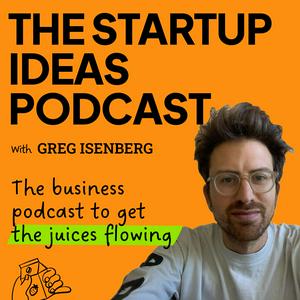
Get your creative juices flowing with The Startup Ideas Podcast. Published twice a week, we bring you free startup ideas to inspire your next venture. Hosted by Greg Isenberg, CEO of Late Checkout and former advisor to Reddit and TikTok. Subscribe so you don't miss out.
For more startup ideas, we created a database of 30+ startup ideas you can take at https://gregisenberg.com/30startupideas
Sitio web del podcastEscucha The Startup Ideas Podcast, Boss Tank: Ser tu propio jefe y muchos más podcasts de todo el mundo con la aplicación de radio.net
Descarga la app gratuita: radio.net
- Añadir radios y podcasts a favoritos
- Transmisión por Wi-Fi y Bluetooth
- Carplay & Android Auto compatible
- Muchas otras funciones de la app
Descarga la app gratuita: radio.net
- Añadir radios y podcasts a favoritos
- Transmisión por Wi-Fi y Bluetooth
- Carplay & Android Auto compatible
- Muchas otras funciones de la app

The Startup Ideas Podcast
Escanea el código,
Descarga la app,
Escucha.
Descarga la app,
Escucha.
The Startup Ideas Podcast: Podcasts del grupo
 Colombia