
Escucha gratis este podcast en la aplicación: Descarga gratuita en la App Store
radio.net
Sleep timer
Favoritos
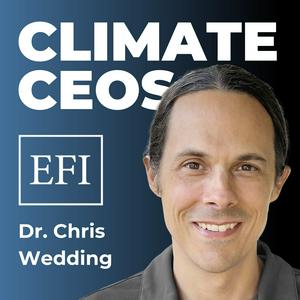
Climate CEOs
Chris Wedding — CEO Coach | CEO, Entrepreneurs for Impact
Último episodio
340 episodios
Can AI Find the Next Billion-Dollar Lithium Deposit? | Atana Elements
23/10/2026 | 46 minWhat if AI could find billion-dollar critical mineral deposits hiding in forgotten geological data?
Atana combines oil-and-gas geology, proprietary datasets, and AI to discover and de-risk lithium and other critical mineral resources faster.
Company bio:
Atana uses AI, data science, and subsurface expertise to discover and de-risk overlooked critical mineral deposits. The company has secured 1.5 million acres of mineral rights and is initially focused on lithium, with plans to expand into other critical minerals.
Guest bio:
Tom Wilson is CEO of Atana and previously helped scale direct lithium extraction company Lilac Solutions through its Series C. His background spans oil and gas, geology, critical minerals, technology, and project development.
Seven things you’ll learn in this episode:
Borrow from adjacent industries. Proven oil-and-gas tools can transform mining.
Proprietary data can be the real AI moat. Models improve quickly; unique datasets are harder to replicate.
Look for stranded assets. New technology can make overlooked resources valuable.
Own the upside. Atana secures mineral rights instead of merely selling technology.
De-risk, then sell. Match each project stage with the right cost of capital.
Make good decisions quickly. Speed often beats waiting for perfection.
Do 10% more. Small extra efforts compound across work and life.
--
More stuff:
Join our private CEO peer group in energy, infrastructure, industrial tech, and climate tech:
→ entrepreneursforimpact.com
Join 40,000+ and read our free Climate CEOs newsletter:
→ entrepreneursforimpact.substack.com
Listen to similar Climate CEOs podcast episodes:
→ Critical Minerals: $20M for AI-Driven Mining in Nickel, Lithium & Silver Discoveries | Earth AI https://podcasts.apple.com/us/podcast/critical-minerals-%2420m-for-ai-driven-mining-in-nickel/id1561411048?i=1000703979931
→ Lithium Extraction: 40% Lower Costs with Electrochemistry | Lithios: https://podcasts.apple.com/us/podcast/a-new-way-to-extract-lithium-from-americas-hardest/id1561411048?i=1000754012245
→ Sustainable Mining: Microbes Extract Copper & Lithium | Endolith: https://podcasts.apple.com/us/podcast/sustainable-mining-microbes-extract-copper-lithium/id1561411048?i=1000711847281
Help our podcast guests and leave a rating or review on Apple or Spotify.
→ Thanks in advance!
Join 97,000+ and take my (possibly free) course, Renewable Energy & Green Building Entrepreneurship:
→ coursera.org/learn/renewable-energy-entrepreneurshipThe $1.5 Billion Solar Heat Project Replacing Fossil Fuels in Heavy Industry | GlassPoint
20/10/2026 | 53 minIndustrial heat consumes more energy globally than electricity, yet it remains one of the hardest parts of the economy to decarbonize.
GlassPoint has spent nearly two decades figuring out how to make solar heat cheaper than burning fossil fuels at industrial scale.
Company bio:
GlassPoint is an industrial heat company using concentrated solar thermal technology and molten-salt storage to deliver low-cost, 24/7 process heat. Its projects serve energy-intensive industries including aluminum, mining, ethanol, pulp and paper, and oil and gas, with projects ranging from hundreds of megawatts to gigawatt scale.
Guest bio:
Rod MacGregor is the founder and CEO of GlassPoint and a five-time venture-backed entrepreneur with an IPO among his previous companies. He founded GlassPoint to tackle industrial heat, which accounts for roughly 26% of global energy use.
Seven things you’ll learn in this episode:
Why industrial heat is not “hard to abate” so much as “too cheap to abate.”
Why customers buy decarbonization technology for economics and energy security, not primarily climate.
How putting giant solar mirrors inside greenhouses dramatically reduced GlassPoint’s capital and operating costs.
Why combining mature technologies can be more powerful than inventing everything from scratch.
How GlassPoint stores solar heat in molten salt to supply industrial steam day and night.
Why startups should dominate one application and industry before expanding into adjacent markets.
Why entering Middle Eastern markets requires years of local presence and relationship building, not fly-in sales.
--
More stuff:
Join our private CEO peer group in energy, infrastructure, industrial tech, and climate tech:
→ entrepreneursforimpact.com
Join 40,000+ and read our free Climate CEOs newsletter:
→ entrepreneursforimpact.substack.com
Listen to similar Climate CEOs podcast episodes:
→ The Climate Investments Unlocking the Next 100 Projects: https://podcasts.apple.com/us/podcast/the-climate-investments-unlocking-the-next-100-projects/id1561411048?i=1000792745961
→ 7 Lessons for Hard-Tech Startups | Vanessa Chan (Time100 List):https://podcasts.apple.com/us/podcast/7-lessons-for-hard-tech-startups-vanessa-chan-time100-list/id1561411048?i=1000791062281
→ The Climate Tech Map: Where Capital and Innovation Are Still Missing | Speed & Scale, Doerr Capital:https://podcasts.apple.com/us/podcast/the-climate-tech-map-where-capital-and-innovation/id1561411048?i=1000787128813
Help our podcast guests and leave a rating or review on Apple or Spotify.
→ Thanks in advance!
Join 97,000+ and take my (possibly free) course, Renewable Energy & Green Building Entrepreneurship:
→ coursera.org/learn/renewable-energy-entrepreneurshipThe $440M Bet to Reinvent Climate Innovation | NY Climate Exchange
13/10/2026 | 50 minClimate change may be one of the biggest forces reshaping the global economy, yet we still treat climate collaboration like a pop-up event.
The New York Climate Exchange wants to change that with a $440M first phase on Governors Island that brings business, universities, government, and innovators together year-round.
Guest bio:
Sanjayan Muttulingam is CEO of the New York Climate Exchange and former CEO of Conservation International. A scientist, conservation leader, and former CBS News contributor, he has spent his career connecting climate science, capital, business, and public engagement.
Company summary:
The New York Climate Exchange is building a global climate hub on Governors Island, minutes from Wall Street. Its planned mass-timber, geothermal, and solar-powered campus will combine research, education, workforce development, business collaboration, and convening space, with ambitions to eventually inspire similar exchanges in cities worldwide.—
Seven things you’ll learn in this episode:
1. Build for permanent problems. Don’t treat enduring challenges like pop-ups.
2. Sell opportunity, not fear. Customers need a reason to want the future.
3. Make the economics work. Impact without profitability won’t scale.
4. Execution beats commitments. Ambition is easy; delivery is hard.
5. Ask for help. Do your homework first, then make the ask.
6. Protect your top three. Let lesser priorities fall off the list.
7. Think in decades. Build around forces that outlast short-term cycles.
—
Four more things:
Join our private CEO peer group in energy, infrastructure, industrial tech, and climate tech:
→ entrepreneursforimpact.com
Join 40,000+ and read our free Climate CEOs newsletter:
→ entrepreneursforimpact.substack.com
Help our podcast guests and leave a rating or review on Apple or Spotify.
→ Thanks in advance!
Join 97,000+ and take my course, Renewable Energy & Green Building Entrepreneurship:
→ coursera.org/learn/renewable-energy-entrepreneurshipWhat 45 Climate CEOs Are Teaching Me About Leadership
07/10/2026 | 47 minToday I’m sharing a conversation where the tables are turned: I was a guest on the Supercool podcast with my friend Josh Dorfman, the cofounder of climate tech startup Plantd.
We get into:
Why I built Entrepreneurs for Impact, and what I’ve learned from working closely with 45 investor-backed CEOs.
What climate and energy CEOs are struggling with right now, from fundraising and customers to hiring and scaling.
Why the leadership style that gets a company started often won’t get it through the next stage.
What I learned from moving between environmental science, private equity, entrepreneurship, and teaching at Duke and UNC.
How 25+ years of meditation has changed the way I think about ambition, stress, leadership, and performance.
And why did I create a cartoon version of my photo for this episode? I don't really know.
Check out more episodes with Josh at Supercool:
https://podcasts.apple.com/us/podcast/supercool/id1758404839
--
Extra stuff
Join our private CEO peer group in energy, infrastructure, industrial tech, and climate tech:
→ entrepreneursforimpact.com
Join 40,000+ and read our free Climate CEOs newsletter:
→ entrepreneursforimpact.substack.com
Help our podcast guests and leave a rating or review on Apple or Spotify.
→ Thanks in advance!
Join 97,000+ and take my course, Renewable Energy & Green Building Entrepreneurship:
→ coursera.org/learn/renewable-energy-entrepreneurshipThe Climate Investments Unlocking the Next 100 Projects
02/10/2026 | 12 minMost climate investors ask which project offers the best return. A better question: Which investment makes the next 100 projects easier, cheaper, and faster?
This episode explores the Transition Acceleration Framework developed by CalSTRS, Generate Capital, and Rhodium Group, and why catalytic capital can have an impact far beyond a single project.
Seven things you’ll learn in this episode:
Why the best climate investment may be the one that unlocks the next 100 projects.
How catalytic capital can lower costs and risks for future projects.
Why first-of-a-kind projects often fall between venture capital and infrastructure finance.
How early projects can build supply chains, workforce, permitting pathways, and customer confidence.
Why different stages of commercialization require different types of capital.
How investors can measure impact beyond the emissions reduced by a single project.
Why the biggest opportunity may be funding the transition from 0 → 1, so conventional capital can fund 1 → n.
Read more here:
https://entrepreneursforimpact.substack.com/p/where-does-the-next-climate-dollar
--
Are you a VC- or PE-backed CEO building in energy, infrastructure, or climate tech?
Join 50 CEOs, plus 50 investors and post-exit founders, who help each other make better decisions on capital, strategy, scaling, and leadership.
See if the CEO community is a fit → entrepreneursforimpact.com
Get smarter on energy, infrastructure, and climate tech in 2 minutes.
Join 40,000+ professionals getting practical insights on startups, investing, commercialization, strategy, and leadership.
Get the free newsletter → entrepreneursforimpact.substack.com
Help more people find this podcast.
If this episode was useful, take 20 seconds to follow the show or leave a rating on Apple Podcasts or Spotify.
It helps bring these conversations to more entrepreneurs, investors, and executives.
Más podcasts de Economía y empresa









Podcasts a la moda de Economía y empresa























Acerca de Climate CEOs
The leading twice-weekly, ad-free podcast for entrepreneurs, investors, & executives in energy, infrastructure, & climate. Get practical insights on raising capital, commercialization, business strategy, scaling startups, project finance, M&A, corporate innovation, and executive leadership. Explore AI infrastructure, data centers, power and grid, nuclear energy, critical minerals, energy storage, industrial technology, advanced manufacturing and materials, geothermal, biotech, carbon removal, forestry, mobility, and climate tech. Plus, career advice, healthier habits, and book recommendations.
Sitio web del podcastEscucha Climate CEOs, Dinstinto y muchos más podcasts de todo el mundo con la aplicación de radio.net
Descarga la app gratuita: radio.net
- Añadir radios y podcasts a favoritos
- Transmisión por Wi-Fi y Bluetooth
- Carplay & Android Auto compatible
- Muchas otras funciones de la app
Descarga la app gratuita: radio.net
- Añadir radios y podcasts a favoritos
- Transmisión por Wi-Fi y Bluetooth
- Carplay & Android Auto compatible
- Muchas otras funciones de la app

Climate CEOs
Escanea el código,
Descarga la app,
Escucha.
Descarga la app,
Escucha.
Climate CEOs: Podcasts del grupo
 Colombia