
Escucha gratis este podcast en la aplicación: Descarga gratuita en la App Store
radio.net
Sleep timer
Favoritos
145 episodios
138 - Could Europe Defend Itself Without the US?
22/06/2026 | 1 h 47 minLong treated as the immovable foundation of European security, America’s role in NATO is now being questioned more openly than at any point in decades, as Washington signals doubts about its commitment to the continent and debates whether US forces should be pulled back toward other theatres. On paper, Europe still looks formidable. Its militaries outspend Russia, field large numbers of troops, aircraft, ships, and armoured vehicles, and are already beginning a major rearmament push. Yet behind those headline numbers lies a much messier reality. Much of Europe’s ability to fight as a single coherent force still depends on the United States: its intelligence networks, satellites, airlift, logistics, targeting systems, command structures, missile defence, and nuclear deterrent. Replacing those capabilities would not simply mean buying more tanks or raising defence budgets, but rebuilding the operating system that allows NATO to function in a crisis. And with Russia’s war economy still running, its northern military districts being rebuilt, and the Baltic states sitting exposed on NATO’s front line, the question is not just whether Europe could defend itself without America, but whether it could do so quickly enough. Our panel of experts examines what the US still provides, what Europe would need to replace, and whether Moscow’s timelines may move faster than Europe’s.
- Ruben Stewart (IISS)
- Ben Barry (IISS)
- Neil Melvin (UI)
- Gen. Philip Breedlove (Fmr. Supreme Allied Commander for Europe)
Intro - 00:00
PART I - 02:47
PART II - 28:06
PART III - 41:26
PART IV - 1:05:20
Outro - 1:31:31
Follow the show on https://x.com/TheRedLinePod
Follow Michael on https://x.com/MikeHilliardAus
Support the show at: https://www.patreon.com/theredlinepodcast
Submit Questions and Join the Red Line Discord Server at: https://www.theredlinepodcast.com/discord
For more info, please visit: https://www.theredlinepodcast.com/
Learn more about your ad choices. Visit megaphone.fm/adchoices137 - Exclusive: We Toured One Of Europe’s Most Secretive Tank Factories
31/03/2026 | 15 minOnce synonymous with Europe’s past wars and fading heavy industry, the tank factory has re-emerged as one of the continent’s most guarded and politically charged symbols amid rearmament, strategic anxiety, and a renewed push for deterrence on NATO’s eastern flank. In this special exclusive episode, Michael and two special guests are granted rare access inside one of Europe’s most secretive tank factories to examine the newest generation of armoured vehicles now moving into production. From armour protection and fire control to manufacturing timelines, battlefield doctrine, and the industrial logic behind Europe’s current defence buildup, the visit offers a close look at how these platforms are being designed, built, and sold as part of a broader strategy of containment. But behind the polished production lines and bold promises lies a deeper set of questions about scale, readiness, and whether Europe’s industrial base can actually deliver what its strategic environment now demands. After the tour, the panel sits down to discuss the specifications, the doctrine, and the role this new generation of tanks is likely to play in Europe’s military posture.
- James Ker-Lindsay (Prof. James Ker Lindsay)
- David Schroeder (The Cold War)
Follow the show on https://x.com/TheRedLinePod
Follow Michael on https://x.com/MikeHilliardAus
Support the show at: https://www.patreon.com/theredlinepodcast
Submit Questions and Join the Red Line Discord Server at: https://www.theredlinepodcast.com/discord
For more info, please visit: https://www.theredlinepodcast.com/
Learn more about your ad choices. Visit megaphone.fm/adchoices136 - The Middle Corridor: Reality Vs. Rhetoric
17/03/2026 | 1 h 41 minPreviously dismissed as a niche academic concept and a talking point for Central Asia specialists, the Middle Corridor has re-emerged as one of the most discussed trade routes in Eurasia amid war, sanctions, and growing instability across the world’s maritime chokepoints. Running from western China through Central Asia, across the Caspian, through the Caucasus and on toward Europe, the corridor promises a route that bypasses Russia, avoids Iran, and reduces dependence on vulnerable sea lanes through Hormuz, Suez, and the Red Sea. Yet behind the hype lies a much messier reality. The route is fragmented, expensive, capacity-constrained, and still plagued by border delays, port bottlenecks, gauge breaks, and political risk stretching from Kazakhstan to Georgia. But as China searches for strategic redundancy, Europe looks for alternatives to the Russian route, and Central Asia seeks deeper regional integration and greater leverage between Moscow and Beijing, the question remains: is the Middle Corridor a viable new artery of Eurasian trade, or merely an overpriced hedge for a more dangerous world? Our panel of experts examines the economics, the geopolitics, and the hard limits of the route in 2026.
- S. Frederick Starr (Central Asia -Caucasus Institute)
- Bruce Pannier (Foreign Policy Research Institute)
- Peter Leonard (CAPS Unlock)
- Eric Rudenshiold (Caspian Policy Center)
Intro - 00:00
PART I - 03:20
PART II - 23:08
PART III - 50:12
PART IV - 1:03:39
Outro - 1:23:54
Follow the show on https://x.com/TheRedLinePod
Follow Michael on https://x.com/MikeHilliardAus
Support the show at: https://www.patreon.com/theredlinepodcast
Submit Questions and Join the Red Line Discord Server at: https://www.theredlinepodcast.com/discord
For more info, please visit: https://www.theredlinepodcast.com/
Learn more about your ad choices. Visit megaphone.fm/adchoices135 - Is China the Kingmaker in Myanmar’s Civil War?
10/02/2026 | 1 h 47 minOnce hailed as a beacon of democratic reform in Southeast Asia, Myanmar has devolved into a fractured state defined by a brutal, multi-front civil war following the 2021 military coup. The Junta clings to power in the central cities through terror and forced conscription, while a patchwork of resistance forces controls the periphery but struggles with donor fatigue and ammunition shortages. Yet, following the shockwaves of Operation 1027 and the rise of a narcotics-and-scam-fueled war economy, the conflict has shifted. China, the region’s hesitant kingmaker, is now applying direct pressure on both sides to secure its strategic access to the Indian Ocean. With the country effectively split and neither side possessing the strength to deliver a knockout blow, the question remains: is Myanmar destined to fracture like Yugoslavia, or can a unified state still emerge from the ashes? Our panel of experts examines the stalled frontlines, Beijing’s evolving strategy, and the grim reality of who, if anyone, can actually govern the nation in 2026.
On the panel this week:
- Zachary Abuza (National Defence University)
- Derek Mitchell (CSIS)
- Jason Tower (GI-TOC)
- Steve Ross (Stimson Center)
Intro - 00:00
PART I - 02:15
PART II - 34:55
PART III - 1:01:52
PART IV - 1:15:09
Outro - 135:15
Follow the show on https://x.com/TheRedLinePod
Follow Michael on https://x.com/MikeHilliardAus
Support the show at: https://www.patreon.com/theredlinepodcast
Submit Questions and Join the Red Line Discord Server at: https://www.theredlinepodcast.com/discord
For more info, please visit: https://www.theredlinepodcast.com/
Learn more about your ad choices. Visit megaphone.fm/adchoices134 - How Important are Strategic Bombers in 2025?
08/09/2025 | 1 h 13 minOnce the spearhead of Allied victory in World War II and the backbone of nuclear deterrence in the early Cold War, strategic bombers are often dismissed today as relics of a bygone era. Yet three powers, the United States, Russia, and China, continue to field formidable bomber fleets. Washington employs them for precision strikes in contested airspace across the globe, Moscow for launching missile salvos into theatres like Syria and Ukraine, and Beijing as a key secondary strike asset. Now, with all three preparing to unveil next-generation platforms that promise capabilities well beyond their current fleets, the question is clear: how will these aircraft shape the battlefields of 2025, and which nation will bring its new bomber to the skies first? Our panel of experts examines the evolving role of strategic bombers and what these upcoming platforms could mean for the balance of power in the air.
On the panel this week:
- Col. David Gordon (United States Air Force)
- Valeriy Akimenko (Conflict Studies Research Centre)
- Bill Sweetman (Airpower Consultant)
Intro - 00:00
PART I - 03:01
PART II - 27:40
PART III - 46:40
Outro - 1:02:27
Follow the show on https://x.com/TheRedLinePod
Follow Michael on https://x.com/MikeHilliardAus
Support the show at: https://www.patreon.com/theredlinepodcast
Submit Questions and Join the Red Line Discord Server at: https://www.theredlinepodcast.com/discord
For more info, please visit: https://www.theredlinepodcast.com/
Learn more about your ad choices. Visit megaphone.fm/adchoices
Más podcasts de Noticias










Podcasts a la moda de Noticias
























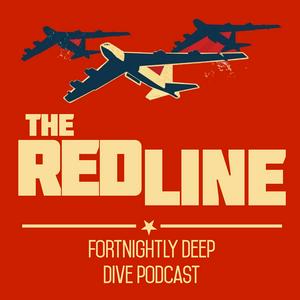
Acerca de The Red Line
Three experts, one Story. Each fortnight we host a panel of international experts diving into the biggest geopolitical stories shaping the news both here and overseas.
Hosted by Michael Hilliard
Sitio web del podcastEscucha The Red Line, La Luciérnaga y muchos más podcasts de todo el mundo con la aplicación de radio.net
Descarga la app gratuita: radio.net
- Añadir radios y podcasts a favoritos
- Transmisión por Wi-Fi y Bluetooth
- Carplay & Android Auto compatible
- Muchas otras funciones de la app
Descarga la app gratuita: radio.net
- Añadir radios y podcasts a favoritos
- Transmisión por Wi-Fi y Bluetooth
- Carplay & Android Auto compatible
- Muchas otras funciones de la app

The Red Line
Escanea el código,
Descarga la app,
Escucha.
Descarga la app,
Escucha.
The Red Line: Podcasts del grupo
 Colombia