

Escucha gratis este podcast en la aplicación: Descarga gratuita en la App Store
radio.net
Sleep timer
Favoritos
88 episodios
Communicating Clearly About Vitamin D | Medical English Podcast (S5E4)
23/08/2026 | 8 minIn this episode of the Medical English Podcast, we break down vitamin D deficiency — one of the most common findings in clinical practice — with a focus on explaining it to patients without reaching for intimidating jargon.
You'll learn how to:
• Pronounce and use "deficiency," "osteoporosis," "supplement," "hypercalcemia," and "rickets" with confidence
• Explain how vitamin D deficiency shows up differently across children, adults, and older adults
• Translate technical terms like "osteomalacia" and "cholecalciferol" into language patients can actually digest • Avoid alarming direct translations like "your vitamin D is toxic"
• Use simple, reassuring alternatives such as "not having enough of a vitamin" and "too much calcium in your blood"
We explore the clinical context behind vitamin D deficiency, the key terminology you need on the ward, and how patient-friendly phrasing lowers anxiety and builds understanding.
This episode is perfect for doctors, nurses, dietitians, international medical graduates, and healthcare professionals preparing for exams like the OET, who want to sharpen both their clinical English vocabulary and patient communication skills.
Enhance your practical medical English with the Medical English Collection: https://australiabiomed.com/med
🎧 Free transcript & practice quiz for this episode: https://australiabiomed.com/mep-s5e4/
Structured lessons, real-world case dialogues, pronunciation practice, and exam preparation — all designed for healthcare professionals who want to communicate with confidence.
Disclaimer: This podcast is for educational purposes only and does not provide medical advice.Nicotine Dependence and Smoking Cessation | Medical English Podcast (S5E3)
16/08/2026 | 11 minIn this episode of the Medical English Podcast, we follow a real consultation with Mark, a patient with a twenty pack-year smoking history, as he works with his doctor to try quitting again — this time with the right support in place.
You'll learn how to:
• Use key vocabulary including "nicotine withdrawal," "cravings," "nicotine replacement therapy (NRT)," "cold turkey," and "relapse"
• Discuss withdrawal symptoms like irritability, difficulty concentrating, and intense cravings
• Explain how NRT and prescription medications work, and why combining medication with behavioural counselling roughly doubles quit success
• Identify a patient's personal triggers and build a quit plan around them
• Reframe a relapse, or "slip," as a normal part of quitting rather than a failure
We explore the full arc of a smoking cessation consultation — from withdrawal and cravings through to treatment planning and follow-up — and how the right language builds trust and motivation.
This episode is perfect for doctors, nurses, GPs, international medical graduates, and healthcare professionals preparing for exams like the OET, who want to sharpen both their clinical English vocabulary and patient communication skills.
Enhance your practical medical English with the Medical English Collection: https://australiabiomed.com/med
🎧 Free transcript & practice quiz for this episode: https://australiabiomed.com/mep-s5e3/
Structured lessons, real-world case dialogues, pronunciation practice, and exam preparation — all designed for healthcare professionals who want to communicate with confidence.
Disclaimer: This podcast is for educational purposes only and does not provide medical advice.Lightheaded, Seeing Stars, and Spinning | Medical English Podcast (S5E2)
09/08/2026 | 6 minIn this episode of the Medical English Podcast, we untangle three patient-reported symptoms that sound similar but mean very different things clinically: lightheaded, seeing stars, and spinning. Getting these right matters — the wrong word can point you toward the wrong diagnosis.
You'll learn how to:
• Distinguish a woozy, pre-syncope "lightheaded" feeling from true rotational vertigo
• Use "seeing stars" correctly for brief, momentary flashes of light — and know when it's the wrong phrase
• Recognise why "spinning" describes the environment moving, not the patient's own body
• Avoid common ESL mistakes like "I am light head" or "I am spinning"
• Choose the correct verb tense depending on whether a symptom is happening now or already happened
We explore the pronunciation, grammar traps, and clinical significance behind each of these three expressions, and why context is everything when a patient describes dizziness.
This episode is perfect for doctors, nurses, ED and triage staff, international medical graduates, and healthcare professionals preparing for exams like the OET, who want to sharpen both their clinical English vocabulary and patient communication skills.
Enhance your practical medical English with the Medical English Collection: https://australiabiomed.com/med
🎧 Free transcript & practice quiz for this episode: https://australiabiomed.com/mep-s5e2/
Structured lessons, real-world case dialogues, pronunciation practice, and exam preparation — all designed for healthcare professionals who want to communicate with confidence.
Disclaimer: This podcast is for educational purposes only and does not provide medical advice.Thyroid Disorders and Patient Communication | Medical English Podcast (S5E1)
05/08/2026 | 8 minIn this episode of the Medical English Podcast, we do a deep dive into hyperthyroidism and hypothyroidism — two of the most common endocrine conditions you'll encounter on the ward — with a focus on translating clinical terminology into language your patients will actually understand.
You'll learn how to:
• Pronounce and use "hyperthyroidism," "hypothyroidism," "goiter," "palpitations," and "autoimmune" with natural clinical rhythm
• Explain an overactive vs. underactive thyroid to patients without relying on frightening jargon
• Describe Graves' disease and Hashimoto's disease as the autoimmune drivers behind each condition
• Avoid alarmist direct translations like "your gland is broken"
• Swap terms like "thyrotoxicosis" for reassuring, patient-friendly phrasing
We explore the clinical context behind these two extremes of thyroid function, the key vocabulary you need to sound confident in the clinic, and how small language choices can make a big difference to a worried patient.
This episode is perfect for doctors, nurses, endocrinology teams, international medical graduates, and healthcare professionals preparing for exams like the OET, who want to sharpen both their clinical English vocabulary and patient communication skills.
Enhance your practical medical English with the Medical English Collection: https://australiabiomed.com/med
🎧 Free transcript & practice quiz for this episode: https://australiabiomed.com/mep-s5e1/
Structured lessons, real-world case dialogues, pronunciation practice, and exam preparation — all designed for healthcare professionals who want to communicate with confidence.
Disclaimer: This podcast is for educational purposes only and does not provide medical advice.Cluster Headaches and Patient Communication | Medical English Podcast (S4E32)
06/05/2026 | 4 minIn this episode of the Medical English Podcast, we do a deep dive into cluster headaches — one of the most painful conditions in medicine — with a focus on how to communicate clearly and compassionately with patients who are in the middle of a severe attack. When a patient is terrified and in agony, the right words are the first dose of medicine.
You'll learn how to:
• Replace clinical jargon with simple, patient-friendly language that de-escalates panic and builds immediate trust
• Explain "unilateral pain," "Horner syndrome," and "nasal congestion" in terms patients instantly understand
• Describe the intensity of cluster headache pain using descriptive language patients can relate to
• Explain oxygen therapy and occipital nerve blocks without causing unnecessary alarm
• Switch confidently between formal clinical language for documentation and simple explanations for patients
We explore why patient-friendly communication matters especially in high-pain emergencies, the anatomy behind cluster headache symptoms, and how mastering this vocabulary helps you connect with patients experiencing some of the most intense pain imaginable.
This episode is perfect for doctors, nurses, neurologists, international medical graduates, and healthcare professionals preparing for exams like the OET, who want to improve both their clinical English vocabulary and patient communication skills.
Enhance your practical medical English with the Medical English Collection: https://australiabiomed.com/med
🎧 Free transcript & practice quiz for this episode: https://australiabiomed.com/mep-s4e32/
Structured lessons, real-world case dialogues, pronunciation practice, and exam preparation — all designed for healthcare professionals who want to communicate with confidence.
Disclaimer: This podcast is for educational purposes only and does not provide medical advice.
Más podcasts de Aprendizaje de idiomas
 Coffee Break ItalianAprendizaje de idiomas, Cursos, Educación
 Inglés desde ceroAprendizaje de idiomas, Educación
 Listening Time: English PracticeAprendizaje de idiomas, Educación
 Easy German: Learn German with native speakers | Deutsch lernen mit MuttersprachlernAprendizaje de idiomas, Cursos, Educación
 Learning English ConversationsAprendizaje de idiomas, Educación
 Simple English News DailyAprendizaje de idiomas, Educación, Noticias, Noticias diarias
 6 Minute EnglishAprendizaje de idiomas, Educación
 Thinking in EnglishAprendizaje de idiomas, Educación
 Learn English with Coffee Break EnglishAprendizaje de idiomas, Cursos, Educación
 Miss Honey: Slow English PodcastAprendizaje de idiomas, Educación
Podcasts a la moda de Aprendizaje de idiomas
- Simple English News DailyAprendizaje de idiomas, Educación, Noticias, Noticias diarias
 InnerFrenchAprendizaje de idiomas, Educación
 Little Talk in Slow FrenchAprendizaje de idiomas, Cursos, Educación
 Italiano con AmoreAprendizaje de idiomas, Educación
 German Stories - Learn German with StoriesAprendizaje de idiomas, Comedia de ficción, Cursos, Educación, Ficción, True crime
 Aprende portugués con Rio and LearnAprendizaje de idiomas, Educación
 Deutsche im Alltag – Alltagsdeutsch | Audios | DW Deutsch lernenAprendizaje de idiomas, Educación
 Vocabulario en InglésAprendizaje de idiomas, Educación
 Aprende alemán escuchandoAprendizaje de idiomas, Educación
 Learn Portuguese | PortuguesePod101.comAprendizaje de idiomas, Cultura y sociedad, Educación, Lugares y viajes
 Beginner Portuguese PodcastAprendizaje de idiomas, Educación
 Langsam Gesprochene Nachrichten | Audios | DW Deutsch lernenAprendizaje de idiomas, Educación
 Italian for BeginnersAprendizaje de idiomas, Educación, Noticias
 The Speak Confident English PodcastAprendizaje de idiomas, Educación
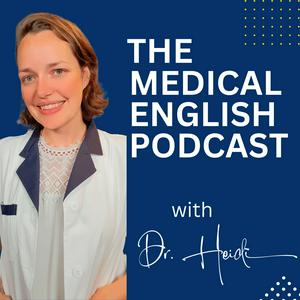
Acerca de The Medical English Podcast
Welcome to The Medical English Podcast, designed to help healthcare professionals sharpen their English language skills. Hosted by Dr. Heidi, this podcast delves into vital medical terminology, common phrases, and specialised language across diverse healthcare settings. From patient consultations to medical conferences, we break down complex jargon, share real-life scenarios, and offer practical tips to elevate your language proficiency. Tune in and elevate your professional communication with The Medical English Podcast!
Sitio web del podcastEscucha The Medical English Podcast, Coffee Break Italian y muchos más podcasts de todo el mundo con la aplicación de radio.net
Descarga la app gratuita: radio.net
- Añadir radios y podcasts a favoritos
- Transmisión por Wi-Fi y Bluetooth
- Carplay & Android Auto compatible
- Muchas otras funciones de la app
Descarga la app gratuita: radio.net
- Añadir radios y podcasts a favoritos
- Transmisión por Wi-Fi y Bluetooth
- Carplay & Android Auto compatible
- Muchas otras funciones de la app
The Medical English Podcast
Escanea el código,
Descarga la app,
Escucha.
Descarga la app,
Escucha.
The Medical English Podcast: Podcasts del grupo
 Colombia