
Escucha gratis este podcast en la aplicación: Descarga gratuita en la App Store
radio.net
Sleep timer
Favoritos
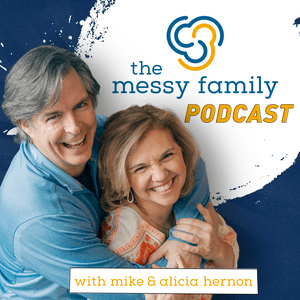
Messy Family Podcast : Catholic Conversations on Marriage and Family
Mike and Alicia Hernon : Catholic Marriage Parent and Family
Último episodio
402 episodios

MFP 403: Learn the Heart of God from the Word of God
19/10/2026 | 56 minIf our children learn who God is by watching us, where are we learning who God is?
Summary
Every parent carries an image of God shaped by experience, but what happens when that image is shaped more by our wounds than by the truth? In this episode, Mike and Alicia talk about forming a true concept of God through Scripture and letting God's Word correct the false images we pick up along the way. They share honestly from their own prayer lives, from praying through the Psalms and Isaiah in a season of exile to a simple way to read, reflect, wrestle, respond, and rest with the Gospels. Through the washing of the feet, the prodigal son, the works of mercy, and the loaves and fishes, they show how Scripture speaks directly into the everyday work of parenting. You'll come away encouraged that you don't need to be a scholar to open your Bible and hear God speak. Listen in!
Key Points
Our image of God is shaped by experience, while Scripture and Church teaching form our concept of God, and praying with Scripture brings the two into alignment.
Scripture is not just history or poetry. Through it, God speaks to us personally.
Because parents form their children's image of God, we need to be steeped in Scripture ourselves.
The ordinary work of family life (serving, forgiving, feeding, clothing) is a real path to holiness.
God prefers to work through our small, faithful efforts, multiplying what little we bring Him.
Discussion Questions
Where might your image of God be shaped more by past experiences than by who God reveals Himself to be in Scripture?
What Scripture passage has changed you, and how could you share it with your spouse this week?MFP 402: When Empathy Becomes Wimpy
12/10/2026 | 53 minIf I understand my child's feelings but refuse to guide them toward what is good, am I fully loving them?
Summary
What if empathy, one of the most important tools in parenting, can sometimes keep us from loving our children well? In this episode, Mike and Alicia explore the difference between understanding a child's feelings and allowing those feelings to guide every decision. Drawing on Scripture and the example of God's fatherly love, they talk honestly about compassion, authority, boundaries, service, and the deep delight parents are called to have in their children. You'll hear practical wisdom on how to love without becoming permissive. Like God's love for us, parental love should seek the child's good without rising and falling according to the child's behavior. Listen in!
Key Points
1. Empathy helps us understand a child's feelings, but it should not determine every parenting decision.
2. Parental authority exists to protect, form, and guide—not to dominate.
3. God models a love that is compassionate, truthful, sacrificial, and steadfast.
4. Children need firm boundaries while knowing their behavior does not diminish their parents' love or delight in them.
5. Healthy detachment allows parents to guide children without making their choices a measure of parental success or worth.
Discussion Questions
1. When can empathy become an excuse to avoid giving our children necessary corrections or consequences?
2. How can we communicate both "Nothing will make me stop loving you" and "This behavior is unacceptable"?
Links
Fr Josh date night Oct 28 - register on site, gifts to give and discounts!
https://messyfamilyproject.org/event/a-virtual-date-night-featuring-fr-josh-johnson/MFP 401: The Four Core Needs of Your Spouse and How to Address Them
05/10/2026 | 1 h 26 minSummary
Marriage does not mean you will perfectly fulfill every need your spouse has, but we are called to be a channel of God's self-giving love. Join us for this powerful conversation with Devin Schadt author of The Marriage Gap: How to Understand, Communicate, and Meet Your Spouse's Four Deepest Needs. We explore the complementary needs of husbands and wives: security and respect, strength and beauty, closeness and physical intimacy, spiritual leadership and shared mission. Devin offers practical wisdom for expressing needs without shame, blame, or manipulation; building trust through attention and sacrifice; and leading a family through prayer. Discover why words can become a trailhead to your spouse's heart—and how grace can draw two people into deeper union. Listen together now.
Resources
https://sophiainstitute.com/product/the-marriage-gap/
Buy the book!
Join the webinar for Lead Like a Dad! https://messyfamilyproject.org/event/lead-like-a-dad-webinar/
Fr. Josh Date Night on Bible in a Year for Families: https://ascensionpress.com/pages/media-season/the-bible-in-a-year-family-edition-with-fr-josh-johnson?srsltid=AU7gw4UDNt7w2sYRSTUYCN9vxJWAo3eKISyYmZswJb6dc7O6Ea0W9mt5MFP 400: From Rules to Responsibility, Giving Teens Freedom
28/09/2026 | 1 h 6 min"We have vastly overprotected our children in the real world. We have to give them more freedom." —Jonathan Haidt
Summary
How much freedom should you give your children—and how do you know when they're ready for more? In this episode, we explore one of parenting's challenging balancing acts: offering children room to grow while providing the guidance and security they still need. Through the relatable picture of teaching a child to swim or drive, we consider why freedom is an art, not a formula, and why every child may need something different. We will tell you some stories from our own experience of our kids' small failures which become valuable preparation for bigger decisions. We will also explain the danger of parents giving too much freedom too early and too little freedom later and why a strong relationship makes wise boundaries easier to receive. If you want to raise responsible, confident young adults while remaining a trusted and loving guide, listen in to this conversation to get some encouragement for your journey.
Key Points
Children need different levels of freedom depending on their maturity and readiness.
Small failures help children develop the wisdom to handle bigger decisions later.
Children thrive when parents combine loving relationships with confident, trustworthy guidance.
Practice giving children freedom in areas of time management, social relationships, money and technology
Couple Discussion Questions
How did our parents give us freedom to make choices growing up? Do we think they gave us too much or too little?
Where can we give our children more freedom?MFP 399: Motherhood - Losing Yourself or Becoming Yourself?
21/09/2026 | 58 minCome to me, all who labor and are heavy laden, and I will give you rest. - Matthew 11:28
Summary
Motherhood changes everything—and sometimes that transformation feels less like a beautiful makeover and more like someone rearranged your whole life while you were trying to sleep. In this honest, hopeful episode, Alicia and guest host Katie Gamboa explore the tension between self-care and sacrificial love. How do mothers give generously without running on empty? We also challenge today's impossible expectations: work, prepare healthy meals, raise happy children, keep the house running, and look effortlessly radiant while doing it all. Spoiler alert: no one was meant to mother alone.
From postpartum support and marriage to community, identity, and grace, this conversation offers encouragement for every mom who has wondered, "Will I ever feel like myself again?" Perhaps the invitation isn't to recover the old you, but to become even more fully yourself—messy, loved, stretched, and strengthened by God. So grab your coffee (reheated for the third time), take a breath, and listen in. You were made to give love—but you were also made to receive care. Let's discover how both can beautifully belong together.
Key Takeaways
The transition to being a mom is huge - don't underestimate how hard it can be and it's ok to be honest about it.
Sacrificial love is not the opposite of self-care. You need to care for yourself in order to love sacrificially.
Don't feel guilty about loosening the "standards" you set for yourself if it helps you to get through the day.
Never forget that you were made for this, but you do need to support your body and heart so you can do what you were made to do.
Couple Discussion Questions
How has being a mother changed you and how you think of yourself? Of your body? Of our marriage?
How can we work together to support our unique roles knowing what a change this has been?
Más podcasts de Cristianismo









Podcasts a la moda de Cristianismo









Acerca de Messy Family Podcast : Catholic Conversations on Marriage and Family
Parenting is not a clean-cut, simple process for those who like to follow the rules. Family life is messy and unpredictable, but it is the greatest adventure you will ever have. We are Mike and Alicia Hernon, parents of 10 children with a growing number of grandchildren, and we would like to invite you into some of the conversations we have had with each other about marriage, parenting, and Catholic family life. Our hope is that our conversation sparks a dialogue between you and your spouse that leads to greater unity and intentional Christian parenting in your home. Listen in to our podcast and start the conversation as we seek to lead our families to heaven.
Visit us at https:///www/MessyFamilyProject.org for resources, guides, links and show notes.
Sitio web del podcastEscucha Messy Family Podcast : Catholic Conversations on Marriage and Family, Enseñanzas: Iglesia de Dios Ministerial de Jesucristo Internacional - IDMJI y muchos más podcasts de todo el mundo con la aplicación de radio.net
Descarga la app gratuita: radio.net
- Añadir radios y podcasts a favoritos
- Transmisión por Wi-Fi y Bluetooth
- Carplay & Android Auto compatible
- Muchas otras funciones de la app
Descarga la app gratuita: radio.net
- Añadir radios y podcasts a favoritos
- Transmisión por Wi-Fi y Bluetooth
- Carplay & Android Auto compatible
- Muchas otras funciones de la app

Messy Family Podcast : Catholic Conversations on Marriage and Family
Escanea el código,
Descarga la app,
Escucha.
Descarga la app,
Escucha.
 Colombia