

Escucha gratis este podcast en la aplicación: Descarga gratuita en la App Store
radio.net
Sleep timer
Favoritos
34 episodios
How strong was a T. rex bite!?
07/10/2026 | 34 minWe're time traveling this week to get to know one of the most famous wild critters to have *ever* roamed the Earth! We're going back 70 million years to meet the infamous T. rex, the apex predator with an astoundingly powerful bite, huge teeth, ginormous legs, and ... surprisingly small arms?
We're joined by an amazing paleontologist, perfect to teach us all about the T. rex and age of dinosaurs! Dr. Roger Benson, Macaulay Curator, Division of Paleontology at the American Museum of Natural History!
This episode wraps up the Wild Critters series, with PBS Nature! See all episodes here: https://www.cumbremedia.com/wild-critters
🦖 Info about the American Museum of Natural History: https://www.amnh.org
🦖 Family friendly "OLogy" pages and activities from the American Museum of Natural History: https://www.amnh.org/explore/ology
Orbit links
💬 Submit your kids' questions! Click here to get started
💛 Support this podcast by joining The Curious Club
🖍️ Episode coloring pages
🎧 Cumbre Kids website
👨👩👧👦 A message for parents about our values: Read moreSea otters: Superheroes of kelp forests!
22/09/2026 | 31 minSea otters aren't just adorable! They're a critically important keystone species for a fascinating underwater ecosystem - kelp forests!
In this episode of the Wild Critters series, we're joined by marine biologist and sea otter expert Leilani Konrad from the Monterey Bay Aquarium, who teaches us about sea otters, the relationship with kelp and sea urchins, how they are on the of the few animals to use tools, and the incredible role of foster moms in raising orphaned pups!
Part of the Wild Critters series with PBS Nature and the National Wildlife Federation.
➡️ Ranger Rick Magazine: https://www.rangerrick.org
➡️ Monterey Bay Aquarium: https://www.montereybayaquarium.org/
➡️ The book that Sam mentioned: "Odder: An Otter's story": link
Orbit links
💬 Submit your kids' questions! Click here to get started
💛 Support this podcast by joining The Curious Club
🖍️ Episode coloring pages
🎧 Cumbre Kids website
👨👩👧👦 A message for parents about our values: Read moreThe race to save 3 mountain lion cubs!
16/09/2026 | 28 minThree mountain lion cubs were left orphaned in the California wilderness, and a team of scientists raced to find them before it was too late!
In this episode of the Wild Critters USA series on Orbit, families meet wildlife ambassador Marco Wendt from the San Diego Zoo Wildlife Alliance. We learn about the incredibly versatile mountain lion - which can be found from Canada all the way down to Argentina - including what makes it a stealthy hunter and how it adapts to an incredible variety of environments!
Part of the Wild Critters series with PBS Nature and the National Wildlife Federation.
Ranger Rick Magazine: https://www.rangerrick.org
San Diego Zoo Wildlife Explorers: https://sdzwildlifeexplorers.org/
San Diego Zoo Wildlife Alliance: https://sandiegozoowildlifealliance.org/
Orbit links
💬 Submit your kids' questions! Click here to get started
💛 Support this podcast by joining The Curious Club
🖍️ Episode coloring pages
🎧 Cumbre Kids website
👨👩👧👦 A message for parents about our values: Read moreHow tiny corals build underwater cities!
02/09/2026 | 31 minDid you know a coral reef, one of the largest structures ever built by a living creature, is made by an animal smaller than a grain of rice!? And that corals aren't plants or rocks at all, but tiny animals related to jellyfish and sea anemones!?
In this episode, marine scientist Dr. Mike Henley from the Smithsonian's National Zoo and Conservation Biology Institute joins Orbit to explore the underwater world of coral reefs! Learn how thousands of tiny coral polyps build a single reef, how corals make babies during massive "spawning" events that look like an underwater snowstorm, why reefs support a quarter of all ocean life, and what coral bleaching really means for a reef's health. We also hear from David Mizejewski of Ranger Rick Magazine about which animals actually eat coral!
➡️ Part of the Wild Critters series, created with PBS Nature and the National Wildlife Federation
➡️ Learn more about wildlife with Ranger Rick Magazine: https://rangerrick.org/
➡️ Explore ocean science with the Smithsonian: https://ocean.si.edu/
➡️ Coral reef resources from NOAA: https://coralreef.noaa.gov/
Orbit Family Conversation Starters: Would you ever want to go snorkeling or scuba diving to see a real coral reef? Which reef in the world would you want to visit?
Continue learning as a family: Play "Build a Coral Reef Neighborhood" together, just like Milam did in this episode! Pick five sea creatures to be your reef neighbors, and talk about why you chose each one.
Orbit links
💬 Submit your kids' questions! Click here to get started
💛 Support this podcast by joining The Curious Club
🖍️ Episode coloring pages
🎧 Cumbre Kids website
👨👩👧👦 A message for parents about our values: Read moreA monarch butterfly's 3,000-mile journey!
26/08/2026 | 29 minEver heard of the SUPER GENERATION of the monarch butterfly!? This little insect goes on one of the most incredible journeys in the whole animal kingdom!
To learn more, we're joined in this episode by Dr. Dorothy Borowy, an ecologist with the U.S. National Park Service! We also have a new friend! Margaret joins Orbit to cohost and help us bring a chrysalis to life for families!
➡️ Part of the Wild Critters series, created with PBS Nature and the National Wildlife Federation
➡️ Learn more about wildlife with Ranger Rick Magazine: https://rangerrick.org/
➡️ Milkweed and Monarch resources from the National Wildlife Federation: https://bit.ly/4qxUsO5
Orbit Family Conversation Starters: If you could make a migration like a monarch butterfly, where would you go and why?
Continue learning as a family: Continue learning about milkweed and monarch butterflies! Plant milkweed in your garden or another species of native plant to help local pollinators!
Orbit links
💬 Submit your kids' questions! Click here to get started
💛 Support this podcast by joining The Curious Club
🖍️ Episode coloring pages
🎧 Cumbre Kids website
👨👩👧👦 A message for parents about our values: Read more
Más podcasts de Educación para niños






Podcasts a la moda de Educación para niños




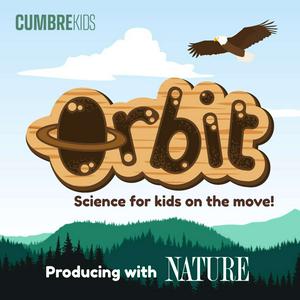
Acerca de Orbit: Science for kids on the move!
Science made simple to help kids better understand the world around them. Publishing "Wild Critters," a series with PBS Nature and the National Wildlife Federation! 🦬 For kids ages 3-11. Perfect for car rides, family adventures, and learning on the go! 'Orbit' builds STEM vocabulary and inspires kids to think like scientists as they explore the amazing world we live in! 🚀 🌟 Send us your questions: https://www.cumbremedia.com/questions 🌟 Our promise to parents: https://cumbremedia.com/our-values
Sitio web del podcastEscucha Orbit: Science for kids on the move!, Brains On! Science podcast for kids y muchos más podcasts de todo el mundo con la aplicación de radio.net
Descarga la app gratuita: radio.net
- Añadir radios y podcasts a favoritos
- Transmisión por Wi-Fi y Bluetooth
- Carplay & Android Auto compatible
- Muchas otras funciones de la app
Descarga la app gratuita: radio.net
- Añadir radios y podcasts a favoritos
- Transmisión por Wi-Fi y Bluetooth
- Carplay & Android Auto compatible
- Muchas otras funciones de la app

Orbit: Science for kids on the move!
Escanea el código,
Descarga la app,
Escucha.
Descarga la app,
Escucha.
Orbit: Science for kids on the move!: Podcasts del grupo
 Colombia