

Escucha gratis este podcast en la aplicación: Descarga gratuita en la App Store
radio.net
Sleep timer
Favoritos
44 episodios
Divergent States Special Report: Robert Rush on the DEA’s Psychedelic Scheduling Proposal
05/10/2026 | 1 h 1 minWhat evidence should justify placing a psychedelic substance in Schedule I, and what happens to research when those restrictions take effect?
Attorney Robert T. Rush joins 3L1T3 and Bryan to discuss the DEA’s proposal to schedule five tryptamines: 4-OH-DiPT, 5-MeO-AMT, 5-MeO-MiPT, 5-MeO-DET, and DiPT.
Rush explains his objections to the government’s evidence, the potential consequences for researchers, and his work defending cognitive liberty. We also revisit the disputed use of Reddit posts in the separate DOI/DOC proceedings and discuss how public comments and hearing requests work.
This Special Report is available in full publicly and on Patreon.
Participate before October 23, 2026
Submit a public comment:
Official comment form on Regulations.gov
Electronic comments close October 23 at 11:59 p.m. Eastern / 10:59 p.m. Central. Reference Docket No. DEA1715. Comments become part of the public record.
Request a hearing:
Official notice and filing instructions
A hearing request is a separate filing, not a submission through the comment form. Interested persons must explain their interest, objections, and position. Requests must be received by October 23 and sent to:
Drug Enforcement Administration
Attn: Administrator
8701 Morrissette Drive
Springfield, VA 22152
Read the notice for full requirements and courtesy-copy instructions.
Researchers interested in participating
Rush is seeking researchers, including students, whose work with these compounds could be affected.
Rights and Reason Project
Robert Rush’s law practice
Email: rrush@rrushlaw.com
Chapters:
00:00 Introduction
04:48 Robert Rush and the Rights and Reason Project
06:18 The DEA’s Proposal and Schedule I
09:11 Research Consequences
11:20 Reddit Posts as Evidence
13:56 The Rulemaking and Hearing Process
16:22 Examining the Government’s Evidence
19:29 Safety Claims and Poison-Center Data
23:04 The DOI/DOC Hearing and Online Reports
30:16 Research Barriers Under Schedule I
35:22 Drug Development and Regulatory Concerns
39:08 Reforming the Controlled Substances Act
40:43 Community Questions: Enforcement and Researchers
44:22 Rush’s Account of the DOI Proceedings
47:59 How to Participate Before October 23
49:44 Comments Versus Hearing Requests
51:20 Researchers Wanted for the Challenge
52:47 Final Takeaway and Judicial Review
54:37 Where to Find Robert Rush
57:34 Closing Discussion and Listener Resources
Send us Fan Mail
Love the podcast? Help keep the conversations going by checking out our official merch shop! We've got t-shirts, hoodies, hats, mugs, stickers, and more, with new designs added regularly.
Every purchase helps support independent, honest conversations about psychedelics, science, and culture.
Shop now: https://divergent-states-shop.fourthwall.com/
FiresideProject.org
Download the app or text/call 62-FIRESIDE
Zendo Project
Our listeners get 10% off the Zendo Project SIT Program with the code DIVERGENTS10
Disclaimer: This post contains affiliate links. If you make a purchase, I may receive a commission at no extra cost to you.
Support the show
Special Thanks to our Macrodosers, Super D and Mike, and our Thumbprint Tier member, Angie on Patreon!
https://linktr.ee/3L1T3ModReality Is Weird Enough: Psychedelic Realism with Danny Forde
22/09/2026 | 1 hWhen a psychedelic experience feels profoundly true, does that mean it actually tells us something true?
Danny Forde, author of Phenomenology of Psychedelic Experiences, joins Divergent States to explore what happens when we take psychedelic experience seriously as an experience rather than reducing it entirely to brain activity or hallucination.
We start with phenomenology itself: what it means to examine consciousness from the standpoint of experience, and why psychedelics may offer an unusually revealing way to study perception, time, selfhood, and the relationship between the self and the world.
From there, the conversation moves through mystical experience, ineffability, ego dissolution, the minimal self, and the difference between something merely feeling true and actually revealing something about reality.
Danny introduces his argument for psychedelic realism: the possibility that while parts of the psychedelic experience are clearly hallucinatory, other aspects may disclose genuine features of consciousness and the mind-independent world. No alternate dimensions or machine elves required. Reality is already weird enough.
In the extended Patreon conversation, we push further into the hardest parts of that argument: the ground of being, naturalism, the “comforting delusion” objection, culturally independent psychedelic insights, and the surprisingly difficult philosophical claim behind the psychedelic cliché that “everything is love.”
Featuring music, “Vibin’” by [Drip].
KEY POINTS
Phenomenology starts with experience and asks how perception, thought, time, selfhood, and the world appear to consciousness.
Psychedelic experience does not have to be treated as something completely separate from ordinary human experience.
Neuroscience can describe what the brain and body are doing without necessarily explaining what an experience is like from the inside.
Psychedelic experiences can meet William James’s criteria for mystical experience: ineffability, noetic quality, passivity, and transiency.
Feeling that something is profoundly true does not automatically mean that it is true.
Danny distinguishes between the complete self, the narrative ego, and the minimal self or bare subjectivity that remains during experience.
“Ego death” may be better understood as a temporary disruption of the narrative ego rather than the complete disappearance of self.
Calling the entire psychedelic experience a hallucination may be inadequate, even if specific visual phenomena clearly are hallucinatory.
Psychedelic realism argues that psychedelics may disclose genuine features of consciousness, selfhood, and reality without requiring supernatural dimensions.
In the extended conversation, Danny explores the ground of being, the comforting delusion objection, culturally independent insights, and the philosophical idea that “everything is love.”
CHAPTER MARKERS
00:00 - The Psychedelic Truth Problem
01:09 - Introducing Phenomenology
02:39 - Making Philosophy Practical
05:19 - Danny Ford and His Book
05:59 - What Is Phenomenology?
08:34 - Psychedelics as Human Experience
09:56 - Intentionality and Consciousness
11:22 - Studying the Structure of Experience
12:34 - Why Phenomenology Fits Psychedelic Research
14:49 - The Experience That Led to Philosophy
17:52 - Psychedelics and the Limits of Language
19:48 - Neuroscience Versus Lived Experience
21:45 - What Makes an Experience Mystical?
22:22 - William James’ Four Marks of Mystical Experience
25:00 - Monk Versus TV Dinner
29:16 - Felt Truth Versus Actual Truth
32:36 - Ego-Free Seeing
33:25 - Self, Ego, and Minimal Self
36:27 - What Remains After Ego Dissolution?
38:19 - Time, Individuality, and the Ego
40:00 - Why “Hallucination” Is Inadequate
41:58 - Defining Psychedelic Realism
43:18 - Can Psychedelics Reveal Objective Truth?
46:17 - What Danny Wants Readers to Take Away
47:48 - Finding Danny Ford’s Work
52:13 - The Questions That Remain
54:31 - Brian’s Take on Psychedelic Realism
55:46 - A Middle Ground Between Certainty and Dismissal
56:24 - The Extended Patreon Conversation
Send us Fan Mail
Love the podcast? Help keep the conversations going by checking out our official merch shop! We've got t-shirts, hoodies, hats, mugs, stickers, and more, with new designs added regularly.
Every purchase helps support independent, honest conversations about psychedelics, science, and culture.
Shop now: https://divergent-states-shop.fourthwall.com/
FiresideProject.org
Download the app or text/call 62-FIRESIDE
Zendo Project
Our listeners get 10% off the Zendo Project SIT Program with the code DIVERGENTS10
Disclaimer: This post contains affiliate links. If you make a purchase, I may receive a commission at no extra cost to you.
Support the show
Special Thanks to our Macrodosers, Super D and Mike, and our Thumbprint Tier member, Angie on Patreon!
https://linktr.ee/3L1T3ModThe Missing Piece of Psychedelics: Global Psychedelic Society on Community
09/09/2026 | 1 h 7 minWhat if one of the biggest things missing from the modern psychedelic conversation isn't another drug, therapy, or clinical protocol, but community?
In this episode of Divergent States, 3L1T3 sits down with Mike Margolies of the Global Psychedelic Society, a worldwide network connecting hundreds of local psychedelic communities.
They explore what community can provide that a clinic can't, and why problems like isolation, addiction, depression, and trauma can't always be understood solely at the level of the individual. Mike lays out a vision of psychedelic communities where education, preparation, peer support, integration, and relationships with experienced peers and elders form part of a larger social ecosystem.
But community isn't automatically healthy.
The conversation turns to the harder questions: How do psychedelic communities prevent themselves from becoming echo chambers? What happens when facilitators or leaders abuse their power? How do you create accountability without immediately resorting to public shaming or cancellation? And how do community organizations remain financially sustainable without becoming sales funnels for therapists, facilitators, entrepreneurs, or spiritual teachers?
They also discuss the Global Psychedelic Society's decentralized model, the challenges facing local societies, ethical monetization, Zendo-style peer support, and what psychedelic communities could look like in a post-prohibition future.
In the extended Patreon edition: Mike sticks around for a looser conversation about recreational psychedelic use, tripping at concerts, why psychedelic culture sometimes takes itself way too seriously, the "high holy hippies," and what his ultimate no-responsibility psychedelic experience would look like.
Divergent States is independent, long-form conversation about psychedelics without the hype, gurus, or easy answers.
Key Points
1. Psychedelic societies create spaces for education, integration, peer support, and community outside of clinical or ceremonial settings.
2. The Global Psychedelic Society connects hundreds of independent local communities rather than operating them as centralized chapters.
3. Many problems treated as individual mental health issues may also reflect larger problems of isolation, culture, and social systems.
4. Healthy psychedelic communities can provide support before, during, and after psychedelic experiences through trusted peers, elders, preparation, and integration.
5. Community isn't inherently positive. Abuse of power, ego, bad information, and group reinforcement can turn communities into unhealthy echo chambers.
6. Accountability requires learning how to have difficult conversations, including knowing when to call someone in, when to call them out, and when stronger action is necessary.
7. Local autonomy allows psychedelic societies to adapt to different cultures, laws, and community needs while still learning from a larger global network.
8. Sustainable psychedelic communities need ethical ways to fund their work without treating money or monetization as inherently corrupt.
9. Psychedelic organizations have to navigate conflicts of interest and prevent community spaces from becoming sales funnels for facilitators, therapists, spiritual teachers, or businesses.
10. The future of psychedelic community could include sustainable local organizations, permanent community spaces, better-trained leaders, and stronger connections between psychedelic societies around the world.
Music is Grotto by Flintwick
00:00 Community Without the Echo Chamber
07:08 Meet Mike Margolies
09:13 The Origins of the Global Psychedelic Society
14:19 What Community Can Provide That Clinics Can’t
18:04 Are We Medicalizing Social Problems?
20:48 What Does a Healthy Psychedelic Community Look Like?
23:06 Power, Ego, and Unhealthy Communities
25:26 Accountability Without Cancel Culture
32:04 How the Global Psychedelic Society Works
38:15 Sustainability, Volunteers, and Monetization
41:28 Balancing Local Autonomy and Accountability
44:31 When Community Becomes a Sales Funnel
46:56 Zendo Project and Psychedelic Peer Support
50:45 The Future of the Global Psychedelic Society
54:41 Finding or Starting a Local Psychedelic Society
56:09 What Psychedelic Culture Needs to Change
57:40 Extended Edition Preview
01:01:29 Bryan and Lee: What Makes a Healthy Community?
01:06:23 Closing Thoughts
Check out:
https://globalpsychedelic.org/
Send us Fan Mail
Love the podcast? Help keep the conversations going by checking out our official merch shop! We've got t-shirts, hoodies, hats, mugs, stickers, and more, with new designs added regularly.
Every purchase helps support independent, honest conversations about psychedelics, science, and culture.
Shop now: https://divergent-states-shop.fourthwall.com/
FiresideProject.org
Download the app or text/call 62-FIRESIDE
Zendo Project
Our listeners get 10% off the Zendo Project SIT Program with the code DIVERGENTS10
Disclaimer: This post contains affiliate links. If you make a purchase, I may receive a commission at no extra cost to you.
Support the show
Special Thanks to our Macrodosers, Super D and Mike, and our Thumbprint Tier member, Angie on Patreon!
https://linktr.ee/3L1T3ModPortals vs. Pathways: The Real Work After Psychedelics | Jonathan Schecter
25/08/2026 | 1 h 1 minThere’s a big difference between having a psychedelic experience and actually doing something with it.
Jonathan Schecter, host of Vital Point: Pathways to Integration and founder of Pathways Integration, joins us to talk about what happens after the breakthrough. Drawing from his own experiences with psychedelics, meditation, Buddhism, breathwork, somatic practices, and integration coaching, Jonathan explores the gap between having an insight and actually changing your life.
We talk about why the biggest psychedelic experience is not necessarily the most useful one, the role of trauma and nervous system regulation, when psychedelic insights should be questioned rather than followed, and Jonathan’s distinction between “portals” and “pathways”: the dramatic experiences that can suddenly move us somewhere new versus the slower, less exciting work of learning how to live there.
Because eventually the trip ends. You go home. Your relationships, habits, job, and problems are still waiting for you. The question is whether anything actually changed.
In the extended Patreon conversation, we go further into the uncomfortable side of psychedelic integration: whether integration itself is becoming a product, whether some people would be better served by stepping away from psychedelic culture entirely, the medicalization of psychedelics, and why the obsession with heroic doses may sometimes get in the way of the work.
Insight is not integration. A profound realization during a psychedelic experience does not automatically translate into lasting behavioral change.
The trip is only part of the process. Preparation and what happens afterward can matter as much as the altered-state experience itself.
Jonathan’s own path began recreationally. Psychedelic experiences eventually forced him to confront his marriage, relationship with his father, drinking, and the direction of his life.
Meditation became a long-term pathway. Jonathan discusses more than two decades of Buddhist practice, including time spent living and practicing in Tibet.
Integration should not mean someone interpreting your experience for you. Jonathan sees the facilitator’s role as supporting people while allowing them to determine what their experiences mean.
Trauma changed the way he approaches psychedelic work. His own experience with shock trauma led to a greater emphasis on somatic practices, nervous-system regulation, and caution around intense altered states.
Not every psychedelic insight should be acted upon. Sometimes the best response to a seemingly profound revelation is to wait and see whether it still makes sense months later.
Portals and pathways serve different purposes. Psychedelics can create dramatic leaps or “portals,” while practices such as meditation, breathwork, and everyday behavioral changes provide slower and more reliable pathways.
Integration is often repetition, not revelation. “Chop wood, carry water” becomes a central theme: lasting change often appears in ordinary relationships, habits, health, and daily decisions rather than another peak experience.
Psychedelic culture deserves skepticism too. The extended conversation challenges heroic-dose culture, the commercialization of integration, the assumption that everyone needs psychedelics, and the idea that healing can simply be purchased.
Music by Dyl👽Alien - Gaian Radio Transmissions
Chapters:
00:00 – Insight vs. Integration
02:35 – Introducing Jonathan Schechter
05:28 – From Recreation to Intentional Psychedelic Work
09:25 – Meditation, Buddhism, and a Life-Changing Loss
13:19 – When Insight Doesn’t Become Change
17:04 – Becoming an Integration Facilitator
19:23 – Stan Grof, Breathwork, and Altered States
23:09 – The Problem With Gurus and Psychedelic Authority
27:24 – Trauma and the Myth of the “Bad Trip”
28:53 – What Does Integration Actually Mean?
33:28 – Should We Challenge Psychedelic Insights?
35:11 – Slow Down Before Making Life Decisions
38:17 – Portals vs. Pathways
41:18 – Repetition vs. Revelation
44:42 – Coming Home to Yourself
46:41 – What Actually Creates Lasting Change?
49:07 – Jonathan’s Work and Pathways to Integration
49:57 – Extended Conversation Preview
54:06 – Bryan’s Take on the Interview
55:51 – Why the Work Afterward Matters
57:04 – Patreon, Zendo, and Closing
Send us Fan Mail
Love the podcast? Help keep the conversations going by checking out our official merch shop! We've got t-shirts, hoodies, hats, mugs, stickers, and more, with new designs added regularly.
Every purchase helps support independent, honest conversations about psychedelics, science, and culture.
Shop now: https://divergent-states-shop.fourthwall.com/
FiresideProject.org
Download the app or text/call 62-FIRESIDE
Zendo Project
Our listeners get 10% off the Zendo Project SIT Program with the code DIVERGENTS10
Disclaimer: This post contains affiliate links. If you make a purchase, I may receive a commission at no extra cost to you.
Support the show
Special Thanks to our Macrodosers, Super D and Mike, and our Thumbprint Tier member, Angie on Patreon!
https://linktr.ee/3L1T3ModThe Counterculture of Aging: Abbie Rosner on Psychedelics and Elderhood
11/08/2026 | 1 h 6 minWhat can psychedelics offer when the question is no longer “Who am I becoming?” but “What do I do with the life I’ve already lived?”
Abbie Rosner, author of Psychedelics and the Counterculture of Aging, joins 3L1T3 and Bryan for a grounded conversation about psychedelic use among older adults and the possibility of reimagining later life as a period of healing, meaning, creativity, intimacy, and renewed purpose.
Drawing on conversations with 36 older psychonauts, Abbie discusses how maturity and life experience can change a psychedelic journey. They explore psilocybin and aging, mortality and the fear of death, unresolved trauma and shame, grief, spirituality, cognitive liberty, community, and what it means to consciously become an elder.
The conversation also examines the practical realities often missing from discussions about psychedelics and seniors: medication interactions, heart health, medical screening, choosing a trustworthy facilitator, underground ceremonies, state-regulated psilocybin programs, commercialization, informed consent, and the limits of current research.
Abbie also shares her vision for Elder Vision Circles, communities where older adults could prepare, journey, integrate, and support one another through the challenges of aging.
This is not a conversation about finding a fountain of youth. It is about confronting mortality without surrendering curiosity, connection, or the right to explore your own mind.
This episode is for educational purposes and is not medical advice. Psychedelics carry psychological, physical, legal, and social risks, particularly for older adults managing medications or existing health conditions.
Psychedelic use among older adults is not simply nostalgia or an attempt to relive the 1960s.
Maturity, therapy, meditation, loss, and accumulated life experience can fundamentally change a person’s relationship with altered states.
Psychedelics may help older adults examine mortality before they are actively approaching the end of life.
Later-life journeys can create opportunities to process grief, childhood trauma, shame, regret, and relationships that have remained unresolved for decades.
Several older adults Abbie interviewed described their later years as the happiest and most authentic period of their lives.
Conscious elderhood reframes aging as a stage of growth, creativity, activism, service, intimacy, and community rather than inevitable decline.
Older adults face specific risks involving prescription medications, cardiovascular health, medical conditions, mobility, and psychological vulnerability.
Trust, screening, preparation, and integration are essential when selecting a psychedelic facilitator or ceremonial setting.
The distinction between psychedelic therapy, wellness, spirituality, and ordinary human meaning is often much less clear than institutions suggest.
Abbie’s proposed Elder Vision Circles would combine education, community service, psychedelic preparation, group experience, and long-term integration.
Music by Dyl👽Alien - Four Twenty Three
Chapters
00:00 – Why Psychedelic Culture Overlooks Older Adults
02:36 – Aging, Harm Reduction, and Today’s Guest
06:17 – Abbie Rosner Joins the Conversation
06:24 – Returning to Psychedelics Later in Life
09:23 – Why Wait Until Death’s Door?
10:18 – 36 Older Psychonauts and a New Counterculture
13:44 – Psychedelics After 65 and the Questions of Later Life
17:23 – Maturity, Intention, and Conscious Elderhood
20:44 – Psychedelics and the Fear of Aging
24:27 – Letting Go, Mortality, and Living in the Present
28:22 – Love, Shame, and Reclaiming Life at 70
32:03 – Medical Risks, Medications, and Facilitator Screening
36:34 – Legal Access, Underground Ceremonies, and Commercialization
42:37 – Psychedelic Therapy Versus Psychedelic Wellness
45:26 – Integration and Becoming a Better Elder
47:12 – Alzheimer’s, Consent, and Ethical Limits
49:48 – Advice for Psychedelic-Curious Older Adults
51:17 – Reimagining the Meaning of Old Age
53:30 – Public Episode Close and Patreon Preview
Send us Fan Mail
Love the podcast? Help keep the conversations going by checking out our official merch shop! We've got t-shirts, hoodies, hats, mugs, stickers, and more, with new designs added regularly.
Every purchase helps support independent, honest conversations about psychedelics, science, and culture.
Shop now: https://divergent-states-shop.fourthwall.com/
FiresideProject.org
Download the app or text/call 62-FIRESIDE
Zendo Project
Our listeners get 10% off the Zendo Project SIT Program with the code DIVERGENTS10
Disclaimer: This post contains affiliate links. If you make a purchase, I may receive a commission at no extra cost to you.
Support the show
Special Thanks to our Macrodosers, Super D and Mike, and our Thumbprint Tier member, Angie on Patreon!
https://linktr.ee/3L1T3Mod
Más podcasts de Ciencias



Podcasts a la moda de Ciencias




Acerca de Divergent States
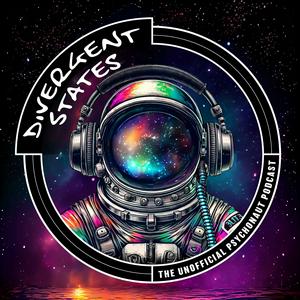
Divergent States cuts through psychedelic hype with grounded, curious conversations about what these substances actually do.Hosted by 3L1T3, founder of r/Psychonaut, the world’s largest psychedelic harm-reduction community, and co-hosted by Bryan, a USMC veteran and advocate for psychedelic healing, the show brings together lived experience, science, and culture without losing its sense of humor.This isn’t a spiritual podcast.This isn’t a marketing platform.No mysticism. No sales pitch. Just real conversations, harm reduction, and honest questions.We explore how psychedelics shape mental health, creativity, and society, from underground use and peer-support communities to clinical trials, therapy rooms, and shifting public attitudes. Some episodes get serious. Some get weird. All of them are grounded in respect for the people actually taking these substances and living with the outcomes.Guests include Rick Doblin, Reggie Watts, Leonard Pickard, Anne Wagner, Hamilton Morris, and Rick Strassman.Divergent States is built on the same principles that made r/Psychonaut work at scale: curiosity without gullibility, openness without losing your footing, and safety without killing the joy.If you’re looking for guru worship, this isn’t your show.If you’re looking for thoughtful, funny, and grounded conversations about psychedelics and the lives they touch, welcome to Divergent States.New episodes every two weeks.
Sitio web del podcastEscucha Divergent States, Radiolab y muchos más podcasts de todo el mundo con la aplicación de radio.net
Descarga la app gratuita: radio.net
- Añadir radios y podcasts a favoritos
- Transmisión por Wi-Fi y Bluetooth
- Carplay & Android Auto compatible
- Muchas otras funciones de la app
Descarga la app gratuita: radio.net
- Añadir radios y podcasts a favoritos
- Transmisión por Wi-Fi y Bluetooth
- Carplay & Android Auto compatible
- Muchas otras funciones de la app
Divergent States
Escanea el código,
Descarga la app,
Escucha.
Descarga la app,
Escucha.
 Colombia