

Escucha gratis este podcast en la aplicación: Descarga gratuita en la App Store
radio.net
Sleep timer
Favoritos
107 episodios
Rethinking Security Analytics with In-Place Intelligence, CEO of Vega, Shay Sandler
08/08/2026 | 41 minIn this episode of Shift AI, Shay Sandler, CEO and co-founder of Vega, joins host Boaz Ashkenazy for a wide-ranging conversation on why the legacy SIEM is breaking down just as security teams need their data the most.
Shay grew up in Israel studying math and physics in a famously competitive class of gifted kids, then spent six years in one of the country's most elite military intelligence units before joining Granulate, a cloud cost optimization company, as one of its first ten employees. Granulate was acquired by Intel for $650 million, and after a year inside Intel, Shay left with his former Granulate colleague Ellie to found Vega — a decision he says was pushed forward by a month of reserve duty after October 7th that reminded him how much he missed solving hard problems with his old team.
The two dig into why traditional SIEMs, built for a pre-cloud world of centralized data, are collapsing under multi-cloud, multi-region, siloed telemetry — and why teams that once filtered data down to save on SIEM costs now need all of it to keep up with threat actors wielding frontier models. Shay walks through Vega's architecture: querying data in place in commodity storage like S3, federating across regions and clouds without duplication or egress costs, and a deterministic, auditable natural-language-to-KQL layer that lets AI agents run threat hunts a human could fully verify.
This episode is for CISOs, security operations leaders, detection engineers, and startup founders building in cybersecurity who want to understand how AI-native architecture, not just AI features, is reshaping enterprise security.
Chapters
[00:00] Introduction: Shay Sandler's path to founding and leading Vega
[02:07] Growing up gifted in math and physics, and finding cybersecurity
[04:18] Six years in an elite Israeli intelligence unit, and the "everything is solvable" mindset
[06:08] First paid job at 14: distributing meat before dawn in southern Israel
[08:37] Granulate, the $650 million Intel acquisition, and missing the startup thrill
[10:43] October 7th reserve duty and the spark to build Vega with co-founder Ellie
[15:04] How legacy SIEM broke under multi-cloud, siloed security data
[17:32] The post-Mythos era: frontier models as tools for threat actors
[23:16] Vega's three primitives: commodity storage, federation, and an AI-native interface
[27:50] Natural language to KQL as a transparent, auditable layer for AI agents
[30:05] AI as a "scalable engineering capability" for lean security teams
[36:40] Velocity as the new core metric, and the closing thought: creativity and engineering
Connect with Shay Sandler
LinkedIn: https://www.linkedin.com/in/shay-sandler-305508107/
Connect with Boaz Ashkenazy
LinkedIn: https://www.linkedin.com/in/boazashkenazy/
Email: boaz@shiftai.fmGoverning Agent-to-Agent Trust at Scale with MuleSoft from Salesforce SVP and GM Andrew Comstock
28/07/2026 | 36 minIn this episode of Shift AI, Andrew Comstock, Senior Vice President and General Manager of MuleSoft from Salesforce, joins host Boaz Ashkenazy for a wide-ranging conversation on governing, securing, and controlling the cost of agentic AI at enterprise scale.
The conversation covers how MuleSoft's API-led integration playbook, built during the on-prem-to-cloud shift, is now extending into what the company calls Agent Fabric — bringing governance and controlled connectivity to agent-to-agent communication. Andrew walks through a concrete example of how two internal agents trusting each other by default can leak a customer's order history, and digs into prompt injection, impersonation, and why the security industry's people-focused compliance frameworks now have to account for reasoning software, not just people. He and Boaz also get into token economics, LLM gateways, intent-based routing between local and cloud models, and the emerging trend of companies repatriating some AI workloads on-premise.
This episode is essential listening for CTOs, CISOs, platform and integration engineers, and IT and product leaders responsible for governing AI spend and agent security as their organizations scale past pilot projects into production.
Chapters
[00:01] Andrew Comstock's path to MuleSoft
[02:06] First job: tax returns and trumpet reeds
[03:21] What MuleSoft does and its extension into Agent Fabric
[05:29] From consumer chatbots to enterprise agent connectors
[07:22] Governance and security at the enterprise level
[10:36] A real example: how two agents can leak an order number
[13:45] Connect AI 2025 vs. 2026 — a year of night-and-day change
[16:28] Mythos, Fable, and preparing for the LLM that breaks your systems
[18:11] Token economics and the true cost of enterprise AI
[20:38] The "AI savior" pattern vs. applying IT discipline to AI
[22:40] Hybrid deployments, local models, and intent-based routing
[27:13] Why AI's uneven acceleration makes prioritization more valuable
[28:57] The two-word answer: "coming soon"
Connect with Andrew Comstock
LinkedIn: https://www.linkedin.com/in/andrewcomstock/
Connect with Boaz Ashkenazy
LinkedIn: https://www.linkedin.com/in/boazashkenazy/
Email: info@shiftai.fmTeaching Discernment in the Age of AI and Higher Education with UW Vice Provost for AI Noah Smith
25/07/2026 | 25 minIn this episode of Shift AI, Noah Smith, Vice Provost for AI at the University of Washington and Senior Director of NLP Research at the Allen Institute for AI, joins host Boaz Ashkenazy for a wide ranging conversation on how universities are preparing for a workplace increasingly run by AI agents.
Noah's path wound from a PhD at Johns Hopkins to a tenured professorship at Carnegie Mellon, until a call from UW pulled him west in 2015 to help build out its natural language processing faculty. A few years later he took on a second role leading a research team at the Allen Institute for AI, and this past November added a newly created role as UW's first Vice Provost for AI.
The conversation covers how faculty across UW are experimenting with AI in the classroom, from an interactive logic textbook in the philosophy department to new AI literacy courses, and digs into OLMo, the fully open language model project Noah leads at Ai2, unpacking why releasing the weights, code, and training data together, not just an API, matters for regulated industries, universities, and anyone who wants to retrain a model rather than just prompt it.
Noah lays out a scenario where 80 percent of entry level work gets done by autonomous agents and argues the skill universities need to double down on is not AI literacy so much as discernment, the ability to unwrap a problem and figure out what questions to ask.
This one is for university administrators, provosts, and faculty grappling with AI policy, as well as founders and engineers building on open source models, and anyone curious how a major research university is trying to get ahead of the agentic era instead of just reacting to it.
Chapters
[00:05] Welcome to Shift AI, live from UW's Foster School of Business
[03:44] Noah's path from Carnegie Mellon to UW's Vice Provost for AI
[06:08] Bagging groceries: Noah's first paid job
[08:11] Six months in: what surprised Noah most about the role
[09:22] How AI is reshaping teaching and pedagogy at UW
[11:33] Preparing students for a world where agents do 80 percent of the work
[14:08] Inside the Allen Institute for AI and the origins of OLMo
[15:52] What "fully open" really means for language models
[17:49] Specialized models versus general-purpose models for regulated industries
[19:47] AI governance, security, and UW's new governance committee
[24:35] The future of work in two words: human agency
Connect with Noah Smith
LinkedIn: https://www.linkedin.com/in/noah-smith-0322511a4/
Connect with Boaz Ashkenazy
LinkedIn: https://www.linkedin.com/in/boazashkenazy/
Email: info@shiftai.fmThe End of DevOps and the Rise of Autonomous Cloud with Hyphen AI CEO Jared Wray
16/07/2026 | 35 minIn this episode of Shift AI, Jared Wray, CEO and co-founder of Hyphen, joins host Boaz Ashkenazy for a wide-ranging conversation on how AI is poised to eliminate the complexity of cloud infrastructure and the DevOps role entirely.
Jared shares his unconventional career journey from growing up in a small town in Idaho, where technology barely existed, to washing dishes at 15, teaching himself programming at the local ISP, and eventually founding five startups across cloud computing, energy tech, and developer infrastructure. From bootstrapping Tier 3 (acquired by CenturyLink) to co-founding Palmetto, now one of the largest energy lenders in the nation, Jared's path has been defined by a passion for solving infrastructure problems.
The conversation dives deep into why DevOps has become painfully complex, with developers needing to glue together seven to thirteen different services just to deploy a single application across providers like AWS, Google Cloud, and Cloudflare. Jared explains how Hyphen is using AI to abstract away this complexity by asking developers only for business rules like uptime requirements and performance needs, then letting the AI determine the right architecture, deploy it, and operate it autonomously.
Boaz and Jared explore why tools like Claude Code and other coding agents still cannot handle the full deployment lifecycle, what it would look like if AI agents replaced PagerDuty by calling you during an outage with a diagnosis and recommendation, and why the future of infrastructure is an autonomous cloud where humans are decision makers and agents handle everything else. The episode closes with a forward-looking discussion on agent-only companies, the death of cloud certifications, and why Jared believes DevOps was a good idea that we ran too long.
This episode is essential listening for CTOs, platform engineers, and startup founders who want to understand how AI is moving beyond writing code to fundamentally transforming how software is deployed, operated, and scaled.
Chapters
[00:00] From Pocatello to Five Startups: Jared's Career Journey
[02:49] Building Fonz, Co-founding Palmetto, and Finding Passion in Infrastructure
[06:05] Why AI Led Jared Back to Infrastructure with Hyphen
[07:05] First Job as a Dishwasher and Breaking Into Tech
[08:46] What Is DevOps and Why Does It Exist
[10:49] Why Cloud Infrastructure Has Become So Painfully Complex
[12:36] How AI Can Apply Best Practices Without Reinventing the Wheel
[14:35] The Hyphen Developer Experience: Business Rules Over Architecture
[17:14] Why Claude Code and Coding Agents Cannot Solve Infrastructure Yet
[20:26] The Full Context Problem: Operating Across Multiple Cloud Providers
[23:07] Autonomous Cloud: When Agents Talk to Agents
[24:17] Replacing PagerDuty: AI Agents That Call You During Outages
[28:47] March Madness, Live Streaming, and Why Five Minutes Feels Like a Lifetime
[30:59] Two Words for the Future of Work: Autonomous Cloud
[33:20] Agent-Only Companies and Why Humans Will Be CEOs
[35:12] DevOps Was a Good Idea We Ran Too Long
[35:41] What Is Next for Hyphen
Connect with Jared Wray
LinkedIn: https://www.linkedin.com/in/jaredwray/
Email: jw@hyphen.ai
Connect with Boaz Ashkenazy
LinkedIn: https://www.linkedin.com/in/boazashkenazy/
Email: info@shiftai.fmThe Case for Deterministic AI with Logical Intelligence CSO Patrick Hillmann
07/07/2026 | 38 minIn this episode of Shift AI, Patrick Hillmann, Chief Strategy Officer at Logical Intelligence, joins host Boaz Ashkenazy for a conversation about why the next era of AI cannot be built on probability alone.
Patrick shares his unconventional path into AI, from crisis communications and cybersecurity work at Edelman and General Electric, to steering Binance through its most turbulent years and a major DOJ settlement. At Logical Intelligence, Patrick now works alongside Yann LeCun, a Fields Medalist, and engineers from Meta, Google, and Cruise to build deterministic, energy-based reasoning models.
Patrick explains why LLMs behave like a confident intern, fast and articulate, but wrong in ways you only catch if you already know the answer, and why critical systems like power grids, hospitals, and self-driving cars need a layer of certainty that probabilistic systems cannot provide. He and Boaz dig into Logical Intelligence's benchmark results, including a 98% score on the notoriously difficult Putnam math competition, and a public Sudoku test where their energy-based model, Kona, beat every major LLM combined while running on a fraction of the compute cost.
This episode is essential listening for CTOs, technical leaders, and anyone trying to understand what comes after the current generation of large language models.
Chapters
[00:00] Patrick's Improbable Path: From Grad School to the Front Lines of a Geopolitical Crisis
[02:43] From Binance to Chief Strategy Officer at Logical Intelligence
[02:54] The First Paid Job: Unloading UPS Trucks in 100 Degree Heat
[04:31] The UPS Lesson That Still Shapes How He Thinks About Work
[04:47] Why LLMs Are Confident Guessing Machines, Not Truth Machines
[07:14] The Team Behind Logical Intelligence: A Fields Medalist, Yann LeCun, and Math Olympiad Engineers
[08:55] Is Logical Intelligence Betting Against LLMs?
[10:32] The AI Sandwich: Where LLMs, Reasoning Layers, and World Models Fit
[12:36] The Putnam Benchmark and Why Formal Proofs Don't Get Partial Credit
[15:44] What Is an Energy-Based Model, Really?
[19:54] Eve Badia's 15-Year Path to the Energy-Based Reasoning Model
[22:04] Formal Verification and the Future of Secure Code Generation
[23:33] When Unverified Code Fails: The Molson Coors Ransomware Story
[25:39] Why AI Coding Tools Create Rat's Nests Engineers Can't Debug
[28:53] The Sudoku Test: 98% Accuracy for $4 vs $14,000 for the Leading LLMs
[31:13] ByteDance, China, and the Race for Formal Methods
[33:42] Two Words for the Future of AI: Chaotic Determinism
[37:12] Where to Follow Logical Intelligence and Founder Eve Badia
Connect with Patrick Hillmann
LinkedIn: https://www.linkedin.com/in/crisiscommunications
Connect with Boaz Ashkenazy
LinkedIn: https://www.linkedin.com/in/boazashkenazy/
Email: info@shiftai.fm
Más podcasts de Tecnología
 Conectados FMTecnología
 DisintegratorTecnología
 Santiago Bilinkis – Futuro en ConstrucciónTecnología
 Día UnoTecnología
 All-In with Chamath, Jason, Sacks & FriedbergEconomía y empresa, Empresa, Inversión, Salud y forma física, Tecnología
 The Instagram Stories - Social Media NewsEconomía y empresa, Marketing, Noticias, Noticias tecnológicas, Tecnología
 صوت التك Sowt el-TechTecnología
 LegalTech RadioTecnología
 AcquiredEconomía y empresa, Inversión, Tecnología
Podcasts a la moda de Tecnología
 Accidental Tech PodcastTecnología
- Santiago Bilinkis – Futuro en ConstrucciónTecnología
 The AI in Business PodcastAdministración, Ciencias, Economía y empresa, Tecnología
 Syntax - Tasty Web Development TreatsNoticias, Noticias tecnológicas, Tecnología
 Manufacturing Happy HourCarrera, Economía y empresa, Educación, Tecnología, Tutoriales
 TokenizedEconomía y empresa, Inversión, Noticias, Noticias tecnológicas, Tecnología
- The Instagram Stories - Social Media NewsEconomía y empresa, Marketing, Noticias, Noticias tecnológicas, Tecnología
- Conectados FMTecnología
 Nosotros Los ClonesTecnología
 The Real Python PodcastTecnología
 Espresso con VictorTecnología
 AI Today PodcastTecnología
 LINUX UnpluggedNoticias, Noticias tecnológicas, Tecnología
 AppsMac en 8 minutosTecnología
 The Pragmatic EngineerNoticias, Noticias tecnológicas, Tecnología
 Apple EventsNoticias, Noticias tecnológicas, Tecnología
 DataFramedEconomía y empresa, Educación, Tecnología
 The Stack Overflow PodcastAdministración, Cultura y sociedad, Economía y empresa, Tecnología
 Loop Infinito (by Xataka)Tecnología
- All-In with Chamath, Jason, Sacks & FriedbergEconomía y empresa, Empresa, Inversión, Salud y forma física, Tecnología
 idearVlogEducación, Noticias, Noticias tecnológicas, Tecnología, Tutoriales
 Training DataEconomía y empresa, Tecnología
 Topes de Gama UnpluggedTecnología
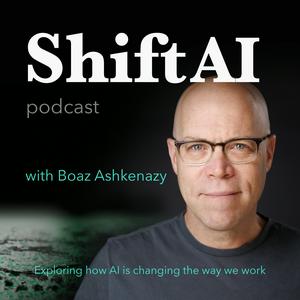
Acerca de Shift AI
Shift AI explores how AI and ML is changing the way that we work in the digital age. The show's creator Boaz Ashkenazy interviews thought leaders who are redefining how businesses and employees will be impacted by emerging technology today and in the future | Visit shiftaipodcast.com
Sitio web del podcastEscucha Shift AI, Conectados FM y muchos más podcasts de todo el mundo con la aplicación de radio.net
Descarga la app gratuita: radio.net
- Añadir radios y podcasts a favoritos
- Transmisión por Wi-Fi y Bluetooth
- Carplay & Android Auto compatible
- Muchas otras funciones de la app
Descarga la app gratuita: radio.net
- Añadir radios y podcasts a favoritos
- Transmisión por Wi-Fi y Bluetooth
- Carplay & Android Auto compatible
- Muchas otras funciones de la app
Shift AI
Escanea el código,
Descarga la app,
Escucha.
Descarga la app,
Escucha.
 Colombia