
Escucha gratis este podcast en la aplicación: Descarga gratuita en la App Store
radio.net
Sleep timer
Favoritos
82 episodios

#71 - Jennifer Koster: Resilience is the new luxury, for both built and human infrastructure
28/09/2026 | 1 h 41 minWhat if the most important infrastructure in any building is the people inside it?
Jennifer Koster has spent more than 25 years building companies across tech, construction and regenerative development. Along the way she reached a conclusion most engineers never get to: humans are a system too, and we need our own infrastructure to function properly. In this episode we explore both sides of that coin, the built infrastructure and the human one.
For practitioners, Jennifer explains why circularity is still what the built environment gets most wrong. Moving a light fixture into another building is not circularity. Designing a building so that none of it ends up in landfill is. She describes how WerkWell grew from an independent construction management firm (on her figures, projects run 30% over budget and schedule on average) into a building performance consultancy and an innovations group that brings market-proven European solutions into US projects. We cover low-carbon concrete, a particle board made from seaweed, power purchase agreements, aquifer recharge credits, and the (re)Building with Resilience symposium she co-organised after the January 2025 Los Angeles wildfires, where resilience started to look like the new definition of luxury.
Underneath runs a very human story. A dot-com crash that wiped out everything overnight and sent her back to her teenage bedroom in Calgary. A chance conversation with contractors that became a construction career in Los Angeles. A growing unease at building enormous homes nobody lived in. And a family road trip through Europe that ended in a move to the Netherlands. Jennifer shares LivWell, her plan for regenerative communities inspired by blue zones, and her forthcoming book The Truth About Baggage, a journey from awareness to agency.
Chapters:
0:00 Intro
1:59 Guest Intro & the predictable unpredictability of life's journey
5:36 How would Jennifer describe herself?
13:46 Jennifer's journey into construction
23:37 Decarbonization in construction
26:36 WerkWell - A new path in construction and the pivot
42:44 Resilience, a new definition of luxury
54:03 Human Infrastructure
1:09:59 The "Truth about Baggage”
1:22:28 Jennifer's Future Plans
1:23:55 What does the built environment miss?
1:25:41 Q&A Start
1:26:03 What does innovation mean to you?
1:27:38 Key moment, book, event, person
1:33:55 Time Management
1:36:44 Favourite childhood memory
1:37:30 Advice for young professioanls
1:37:56 What would you most like to be remembered for?
1:38:11 Where can people find you?
1:39:09 Final Message
1:40:15 Outro
Detailed shownotes over at: petermbach.com/podcast for more in-depth information about each episode.
Join the community over at: linkedin.com/company/tgcpodcast and let's connect across the world!
Subscribe and listen to the podcast (and do please leave a review/rating) on Spotify, Apple Music, YouTube or wherever you get your podcasts from.
Your subscription/follow will greatly help the show grow and reach a wider audience.
Hosted by Peter Marcus Bach (www.petermbach.com), follow me on:
X (fomerly Twitter): @petermbach
Instagram: @petermbach87
Subscribe to my channel on YouTube: www.youtube.com/c/PeterMarcusBach/#70 - Tim D. Fletcher: The permeable engineer, saving a stream with its catchment and tanks for platypus
07/09/2026 | 1 h 54 minRain falls on a suburb. It hits roofs, driveways and roads, and within minutes it is in the local creek, running high enough to flood the burrows where baby platypus are sheltering. They can swim, but they still need to breathe. A few dry weeks later the same creek is too shallow for an adult to move through safely. Tim Fletcher has spent his career in the space between those two extremes.
Tim is Professor of Urban Ecohydrology at the University of Melbourne and heads the Waterway Ecosystem Research Group. He was part of the team that built MUSIC, the model now used across Australia to demonstrate stormwater compliance, and he is lead author of the most-cited paper in urban water, the one that sorted out SUDS, LID, BMPs, WSUD and the rest of the alphabet soup. Its conclusion still surprises people. There is no correct term, and there should not be one.
We trace three eras. The Monash years, where six people, a dunce's hat and a very good mentor turned a research idea into software the industry now runs on. Little Stringybark Creek, a world-first attempt to retrofit an entire catchment to save the stream running through it, funded partly by asking residents to bid for tanks and rain gardens in a reverse auction. And Tanks for Platypus, where networked smart tanks release water seven days ahead of a storm and top the creek up when it runs low, working the way a solar battery works for the grid.
Along the way: why he calls himself a permeable engineer, why he cried in the bathroom on his first day in stormwater, and the meeting called to decide who to make redundant that instead lasted ten minutes.
Recorded in person in Lausanne, eighteen years after we met on a dark bike path with a puncture and no repair kit.
Chapters:
0:00 Intro
1:59 Guest Intro & Remembering our first encounter
6:42 Reminiscing about undergraduate times and education
10:39 How would Tim describe himself?
13:10 The WSUD Terminology Debate
21:28 The key barrier to scaling up WSUD
27:09 Tim's Monash Era
31:33 The MUSIC Model
40:40 A 101 on Ecohydrology & the Urban Stream Syndrome
43:32 The Little Stringybark Ck Living Lab
1:03:57 Tim's Tanks for Platypus Project & Real-time Control
1:22:21 What is Tim's biggest lessons learnt so far?
1:25:04 Q&A Start
1:25:12 What does innovation mean to you?
1:28:02 Key moment, book, person, event
1:31:52 If you had a magic wand?
1:33:34 Time Management
1:36:10 Favourite childhood memory
1:38:13 Biggest challenge to date?
1:43:04 Advice for young professionals
1:46:34 What is something you'll regret not doing?
1:47:50 What would you most like to be remembered for?
1:49:57 Where can people find you?
1:52:48 Final Message
1:53:23 Outro
Detailed shownotes over at: petermbach.com/podcast for more in-depth information about each episode.
Join the community over at: linkedin.com/company/tgcpodcast and let's connect across the world!
Subscribe and listen to the podcast (and do please leave a review/rating) on Spotify, Apple Music, YouTube or wherever you get your podcasts from.
Your subscription/follow will greatly help the show grow and reach a wider audience.
Hosted by Peter Marcus Bach (www.petermbach.com), follow me on:
X (fomerly Twitter): @petermbach
Instagram: @petermbach87
Subscribe to my channel on YouTube: www.youtube.com/c/PeterMarcusBach/#69 - Silvia Oppliger: Switzerland's sponge city network, breaking silos and the trouble with a "spongy" word
24/08/2026 | 1 h 25 minAsk ten people what a "sponge city" is and you will get ten different answers. Silvia Oppliger knows this better than most, because asking that question is how she opens almost every conversation she has. It is a good word for catching attention, she says, and a really spongy one for everything after that.
Silvia is an environmental engineer and the coordinator of the Swiss Water Association's National Sponge City Network. Over three years she has pulled federal offices, cantons, municipalities, universities, engineering and architecture associations, spatial planners, landscape architects and even the insurance sector into the same rooms. More than 800 experts across exchange events, six webinars, 80 presentations, a national information platform and a professional certification course.
We get into the parts that rarely make the conference slides. Why Article 7 of the Swiss Water Protection Act arrives too late in a project to change much. Why 26 cantons means 26 water regulations, and what happened when a working group tried to agree on one table. Why some cantonal street laws make it questionable to send rainwater from your own garden onto the road. Why the municipalities moving fastest are not the big cities.
Silvia also tells the story underneath the job. Three mother tongues before she started school. A suit bought at 27 out of nerves, and a room with 70 men in it. And the idea she keeps returning to now, which is that water professionals have to learn "architect" as a language if they want to be heard at all.
Her definition of innovation is worth the listen on its own. Ninety-five per cent of it, she argues, is not technology.
Chapters:
0:00 Intro
1:59 Guest Intro & The Polyglot
8:19 An environmental engineer who connects people
13:54 Regulations and unifying 26 Cantons in Switzerland
15:50 The road to National Sponge Cities Coordinator
21:03 Terminology Discussion and Swiss Sponge City History
26:05 The Swiss Sponge Cities Network
33:46 Swiss Public and Private Water Management
37:16 National differences in priorities and silos
45:38 Communication and Knowledge Exchange Strategies
50:57 Reflecting on the outputs of the first three years
1:00:32 Where the Sponge Cities Network is heading
1:06:35 Silvia's Future Plans
1:07:42 Q&A Start
1:08:05 What does innovation mean to you?
1:09:12 Key moment, event, person
1:12:31 Time Management
1:15:59 Favourite childhood memory
1:17:10 Biggest challenge to date
1:20:42 Advice for young professionals
1:22:27 What would you most like to be remembered for?
1:23:24 Where can people find you?
1:24:13 Final Message
1:24:37 Outro
Detailed shownotes over at: petermbach.com/podcast for more in-depth information about each episode.
Join the community over at: linkedin.com/company/tgcpodcast and let's connect across the world!
Subscribe and listen to the podcast (and do please leave a review/rating) on Spotify, Apple Music, YouTube or wherever you get your podcasts from.
Your subscription/follow will greatly help the show grow and reach a wider audience.
Hosted by Peter Marcus Bach (www.petermbach.com), follow me on:
X (fomerly Twitter): @petermbach
Instagram: @petermbach87
Subscribe to my channel on YouTube: www.youtube.com/c/PeterMarcusBach/#68 - Haris Piplas: "Co-opetition" and the honest city - what urban regeneration should and shouldn't be
03/08/2026 | 1 h 32 minBillions in international money poured into Sarajevo after the siege ended. What got built was a city with more shopping malls and less public green space than the one that had been destroyed. Money was never the constraint. Coordination was.
Haris Piplas is Director of Integrated Urban Solutions International at Drees & Sommer and a lecturer at ETH Zürich. He trained as a landscape architect in Sarajevo, an urban designer in Berlin, and took his doctorate in architecture in Zürich. His argument is that the way the built environment carved itself into separate professions last century has left none of them able to do the actual job. Transforming a place means understanding law, media, budgets, referenda and human psychology, and no architecture school teaches any of it.
We get into what urban regeneration should and should not be, why both neighbours in an argument about one parking space have a legitimate case, how the Commit to Green project is bringing blue-green infrastructure back into a contaminated former landfill in Milan and a landslide-prone site on the edge of Barcelona, and why the recovery of Ukrainian cities cannot wait for a perfect moment that may never arrive.
Haris also talks about the two cities that raised him. Sarajevo, which lost almost everything when the Cold War ended, and Berlin, which gained almost everything. He explains why the "smart city" buzzword is more useful than its critics allow, why architectural competitions bin most of the knowledge they generate, and why the single-name genius architect is a marketing fiction worth retiring. Plus central midfield as a theory of project management, moustaches as a theory of fashion cycles, and a childhood memory from a refugee camp that he still describes as beautiful.
Chapters:
0:00 Intro
1:59 Guest Intro and The Urban Forum
4:23 Drees & Sommer & a little bit of Zurich history
9:44 The fallacy of 20th century hyperspecialization
14:37 Growing up in Sarajevo shaped Haris' drive
18:48 Urban Regeneration: what it should and shouldn't be
25:56 Geopolitics, stakeholders and scaling up urban regeneration
35:10 Baukultur, Inclusivity and the Blue-Green Infrastructure
43:15 Co-op-e-tition and horizontalizing authorship
49:54 AI and the Smart Cities Movement
54:59 A collage of Haris' project work and "bridges”
1:06:23 Heading in the right direction?
1:08:34 What excites Haris about the future?
1:10:40 Q&A Start
1:10:50 What does innovation mean to you?
1:12:45 Key Moment, Book, Person
1:17:08 Time Management
1:20:52 Favourite childhood memory
1:24:31 What would you most like to be remembered for?
1:28:17 Where can people find you?
1:29:54 Final Message
1:31:33 Outro
Detailed shownotes over at: petermbach.com/podcast for more in-depth information about each episode.
Join the community over at: linkedin.com/company/tgcpodcast and let's connect across the world!
Subscribe and listen to the podcast (and do please leave a review/rating) on Spotify, Apple Music, YouTube or wherever you get your podcasts from.
Your subscription/follow will greatly help the show grow and reach a wider audience.
Hosted by Peter Marcus Bach (www.petermbach.com), follow me on:
X (fomerly Twitter): @petermbach
Instagram: @petermbach87
Subscribe to my channel on YouTube: www.youtube.com/c/PeterMarcusBach/#67 - Anastassia Lauterbach: Literacy before fluency, why AI is not a religion and the brain needs training
20/07/2026 | 1 h 48 minMost of us now use AI every day. Very few of us could explain what it is actually doing.
Anastassia Lauterbach thinks that gap is the most dangerous thing about this technology, and she has built a company to close it. She is a linguist, a trained clinical psychologist, a former senior executive at Qualcomm and Deutsche Telekom, a former non-executive director at easyJet, Dun & Bradstreet and Wirecard, and now founder and CEO of AI Edutainment in Basel.
In this episode she draws a line most companies and governments have quietly erased. AI literacy is not AI fluency. Fluency is knowing how to prompt. Literacy is understanding why every large language model hallucinates, where your data goes when you upload it, and when the honest answer is to not use AI at all. Invest only in fluency, she argues, and what you scale is mediocrity.
We work through the four principles of her Responsible AI white paper: changing the architecture itself, radical transparency about failure, literacy as understanding rather than tool training, and the fusion of STEM with the humanities. Along the way we discuss the elevation of AI into a religion complete with its own popes and heretics, why cognitive capital deserves a place next to human capital on the balance sheet, and what an "Ozempic for the brain" would even look like.
There is also a grand piano, absolute pitch, a childhood in Moscow spent hanging oranges on a Christmas tree, the collapse of Wirecard, and a ginger cat who serves as Chief Marketing Officer.
Chapters:
0:00 Intro
1:59 Guest Intro, Basel and Piano
15:15 Anastassia's early journey
21:43 The Brain and critique on today's AI and society
35:49 Anastassia's Mission in AI Literacy
42:34 AI Literacy vs. AI Fluency
48:08 The cognitive challenge and appetite for understanding
51:52 Mediocrity and the need to celebrate human effort
55:18 Education reforms and re-exercising our brain
1:09:37 Reaching the four pillars of Responsible AI
1:19:17 Anastassia's Vision
1:24:05 Q&A Start
1:24:32 What does innovation mean to you?
1:27:14 Key moment, event, person
1:28:22 Time Management
1:32:49 Favourite childhood memory
1:35:16 Biggest challenge to date
1:41:34 Advice for young professionals
1:43:38 What would you most like to be remembered for?
1:43:52 Where can people find you?
1:46:39 Final Message
1:46:58 Outro
Find Anastassia at https://aiedutainment.ai and https://romyandroby.ai
Detailed shownotes over at: petermbach.com/podcast for more in-depth information about each episode.
Join the community over at: linkedin.com/company/tgcpodcast and let's connect across the world!
Subscribe and listen to the podcast (and do please leave a review/rating) on Spotify, Apple Music, YouTube or wherever you get your podcasts from.
Your subscription/follow will greatly help the show grow and reach a wider audience.
Hosted by Peter Marcus Bach (www.petermbach.com), follow me on:
X (fomerly Twitter): @petermbach
Instagram: @petermbach87
Subscribe to my channel on YouTube: www.youtube.com/c/PeterMarcusBach/
Más podcasts de Carrera




Podcasts a la moda de Carrera

Acerca de The Grand Challengers Podcast
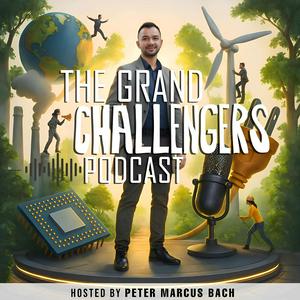
In a world facing climate change, urbanization, and population growth, inspiring individuals are stepping up with innovative solutions. Each episode features passionate guests working at the cutting edge of science, engineering, technology, and design. Through their journeys, they share insights and personal growth while creating new ways of thinking for an uncertain future. Tune in for actionable advice and inspiration for young professionals aiming to make a difference. If you enjoy the show, please hit the follow or subscribe button! That's a small way you can help the show grow and reach many more ears!Show Website: https://www.petermbach.com/podcast/LinkedIn: https://www.linkedin.com/company/tgcpodcast/
Sitio web del podcastEscucha The Grand Challengers Podcast, A Bit of Optimism y muchos más podcasts de todo el mundo con la aplicación de radio.net
Descarga la app gratuita: radio.net
- Añadir radios y podcasts a favoritos
- Transmisión por Wi-Fi y Bluetooth
- Carplay & Android Auto compatible
- Muchas otras funciones de la app
Descarga la app gratuita: radio.net
- Añadir radios y podcasts a favoritos
- Transmisión por Wi-Fi y Bluetooth
- Carplay & Android Auto compatible
- Muchas otras funciones de la app

The Grand Challengers Podcast
Escanea el código,
Descarga la app,
Escucha.
Descarga la app,
Escucha.
 Colombia