
Escucha gratis este podcast en la aplicación: Descarga gratuita en la App Store
radio.net
Sleep timer
Favoritos
504 episodios
Why Is a Solid Dyson Sphere Impossible? - Stellar Energy Capture and the Dyson Swarm | Sleepy Facts About the Universe
24/11/2026 | 30 minGot something to say to this podcast? Send a voicemail, and you might hear yourself on the next episode!
The popular image of a Dyson sphere—a rigid, solid shell enclosing a star—is an engineering impossibility. No known material could withstand the stresses of supporting itself across hundreds of millions of kilometers, and without the ability to orbit, such a shell would catastrophically collapse. This episode explores the physically plausible alternative proposed by physicist Freeman Dyson: a vast, growing swarm of independent orbiting objects, each catching a patch of sunlight that would otherwise escape into the void.
We examine the engineering logic required to build this stellar-scale energy capture system. This includes mining asteroids for raw materials, deploying billions of reflective collectors, and managing the complex orbital mechanics and collision risks of a cloud thickening around a star. We also look at the thermodynamic realities of capturing so much power, specifically how a swarm must radiate waste heat into space as an infrared signature.
I wanted to understand why the popular image of a hollow shell endures when the actual physics point toward a cloud of independent machines. Exploring this question reveals how a civilization might gradually harvest a fraction of a star's output, and how astronomers might one day detect the subtle, structured dimming and infrared glow of such a megastructure.How Do We Test Abiotic Explanations for Signs of Life? - Searching for Extraterrestrial Biosignatures | Sleepy Facts About the Universe
24/11/2026 | 29 minGot something to say to this podcast? Send a voicemail, and you might hear yourself on the next episode!
The search for life beyond Earth is often imagined as a sudden, dramatic discovery, but the reality of planetary exploration is far more careful and incremental. When a rover lands on an ancient lakebed, it carries a suitcase-sized laboratory, a limited power supply, and only a few hours to work. This raises a deceptively simple question: how do you look for life when you cannot assume you would recognize it, and when you cannot bring a full laboratory to test it?
This episode explores the "ladder of life detection," a framework scientists use to organize the search for extraterrestrial life. It is a method that separates what an environment permits from what actually occurred within it. We look at why liquid water and organic molecules are necessary conditions for habitability, but not proof of life, and how researchers test abiotic alternatives to explain potential biosignatures. From the contested structures in the Allan Hills 84001 meteorite to the seasonal methane detected on Mars, the ladder demands that every observation be placed in context before a biological claim is made.
I wanted to understand why public announcements about space exploration so often get compressed into headlines about finding life, and how scientists try to prevent premature conclusions. Some questions sound simple until you try to answer them, and establishing a rigorous, step-by-step method for proving life exists elsewhere is one of the most fascinating technical challenges in modern science.What Would a Second Origin of Life Prove? - The Sample of One Problem | Sleepy Facts About the Universe
23/11/2026 | 28 minGot something to say to this podcast? Send a voicemail, and you might hear yourself on the next episode!
Earth holds a winning ticket to a lottery whose scale we cannot read from the prize itself. Life emerged on our planet almost as soon as the heavy asteroid bombardments subsided and liquid water stabilized. On a geological timescale, this origin is remarkably prompt, leading many to infer that the genesis of life is relatively easy and the universe likely teems with biology. But this apparent lesson contains a hidden flaw rooted in how we observe.
This episode examines the critical distinction between life being possible and life being probable. Because conscious observers could only evolve on a planet where life appeared early enough to allow for billions of years of subsequent biological development, we are necessarily looking at a biased data point. The early appearance of life on Earth is a precondition for our existence, not independent evidence of frequent cosmic origins. To understand how this observational selection bias shapes our reasoning, the episode explores the Bayesian logic of our sample of one, the difficulty of proving a planet is sterile, and the scientific search for a truly independent second data point in our solar system.
Some questions sound simple until you try to answer them. I kept returning to one fundamental problem while working on this episode: we are trying to measure the odds of a cosmic lottery using only the ticket of the winner. Earth proves that life can happen, but it cannot tell us how often it happens. Here, we look at why that distinction matters and what a mission to Mars or the oceans of Europa might finally reveal.What Happens When We Have Only Mapped Five Percent of the Universe? - The Unmapped Universe and the Future of Physics | Sleepy Facts About the Universe
23/11/2026 | 26 minGot something to say to this podcast? Send a voicemail, and you might hear yourself on the next episode!
There is a persistent worry that physics has run its course. With the Higgs boson found, gravitational waves detected, and Einstein's predictions confirmed, the discipline is sometimes treated as a monument to the previous century. If the fundamental particles are known and the Standard Model is complete, what remains for physicists to discover?
This episode examines that fear directly by looking at what physics has achieved recently and what we currently know about the composition of the universe. The atoms and particles we understand constitute roughly five percent of existence. The remaining ninety-five percent consists of dark matter and dark energy, phenomena that remain entirely unidentified. Beyond this cosmic mystery, the nature of scientific progress itself is expanding. By engineering exotic phases of matter like Bose-Einstein condensates and topological insulators, laboratories are now exploring what could be rather than just what is.
I wanted to understand why the claim that physics is finished sounds so plausible, and why it relies on a very narrow definition of progress. While working on this episode, I kept returning to the difference between knowing the rules of a system and understanding the infinite possibilities those rules allow. Join me for a calm look at why the adventure of physics has just begun.Does Life Make a Planet More Habitable? - The Observer Selection Effect and Dead Inhabited Worlds | Sleepy Facts About the Universe
23/11/2026 | 24 minGot something to say to this podcast? Send a voicemail, and you might hear yourself on the next episode!
We naturally assume that life makes a planet more habitable. Plants produce oxygen, forests regulate temperature, and microbes build soils. But the intuition that life automatically tends toward balance is incomplete. The same biological processes that created Earth's breathable atmosphere nearly exterminated the anaerobic life forms that preceded it. The oxygen we depend on today began as a toxic waste product that caused a mass extinction.
This episode examines the dual role of life as a planetary engineer. It explores how organisms manufacture niches and transform worlds, yet also how biological productivity can strip ecosystems of oxygen, trigger climatic shifts, and destabilize the very environments that sustain it. Evolution operates on local reproductive success rather than planetary welfare, meaning there is no built-in thermostat guaranteeing long-term stability. We also look at how the observer selection effect limits our understanding of Earth's persistence, and what this means for the search for biosignatures on distant exoplanets.
I wanted to understand why we assume life will always stabilize its environment, and what happens when we look closely at the evidence. The history of our planet shows that life is a powerful geological force, but it is one without a blueprint. I find this uncertainty deeply compelling, especially as we begin looking for signs of life on worlds that may have already transformed themselves past the point of biological collapse.
Más podcasts de Astronomía





Podcasts a la moda de Astronomía

Acerca de Sleepy Facts About the Universe
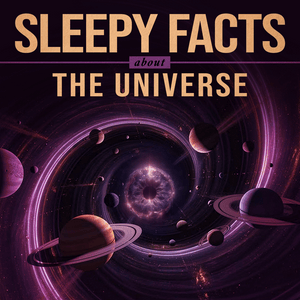
Sleepy Facts About the Universe is a calm astronomy and space science podcast for sleep, relaxation, and quiet curiosity.Each episode explores the universe in a gentle documentary style: stars, planets, galaxies, black holes, nebulae, the Moon, the Sun, cosmic history, space missions, and simple explanations of astrophysics without loud drama or stressful narration.If you enjoy relaxing science podcasts, space facts for sleep, astronomy explained, or peaceful documentaries about the cosmos, this show is designed to keep you curious while letting your mind slow down.Sleepy Facts About the Universe is produced by the small team at sciflix.one. Each episode is built from human-researched facts and written exclusively for this channel by science fiction author Sascha Schmidt and co-authored by Kyle Smith, with a steady focus on factual care, clear explanation, and a soothing bedtime tone.The episodes are narrated by Kyle Smith’s synthetic voice, the familiar anchor voice of our Sleepy Facts series.We are always interested in the questions that keep listeners curious. If there is a space topic, astronomy question, cosmic mystery, or scientific idea you would like us to cover, tell us what you would love to hear next.For topic suggestions, feedback, or collaboration inquiries, contact us at [sleepyfacts@sciflix.one](mailto:sleepyfacts@sciflix.one).
Sitio web del podcastEscucha Sleepy Facts About the Universe, SpaceTime with Stuart Gary y muchos más podcasts de todo el mundo con la aplicación de radio.net
Descarga la app gratuita: radio.net
- Añadir radios y podcasts a favoritos
- Transmisión por Wi-Fi y Bluetooth
- Carplay & Android Auto compatible
- Muchas otras funciones de la app
 Colombia